
Tag Archives: SARS-COV2

PODCAST: FEAR OF VACCINES, CONFUSION OVER ORIGINS OF CORONAVIRUS (sCIENCE)

Science Editor-in-Chief Holden Thorp joins host Sarah Crespi to discuss his editorial on preventing vaccine hesitancy during the coronavirus pandemic. Even before the current crisis, fear of vaccines had become a global problem, with the World Health Organization naming it as one of the top 10 worldwide health threats in 2019. Now, it seems increasingly possible that many people will refuse to get vaccinated. What can public health officials and researchers do to get ahead of this issue?

Also this week, Sarah talks with Science Senior Correspondent Jon Cohen about his story on Chinese scientist Shi Zhengli, the bat researcher at the center of the COVID-19 origins controversy—and why she thinks President Donald Trump owes her an apology.

Finally, Geert Van der Snickt, a professor in the conservation-restoration department at the University of Antwerp, talks with Sarah about his Science Advances paper on a new process for peering into the past of paintings. His team used a combination of techniques to look beneath an overpainting on the Ghent Altarpiece by Hubert and Jan Van Eyck—a pivotal piece that showed the potential of oil paints and even included an early example of painting from an aerial view.
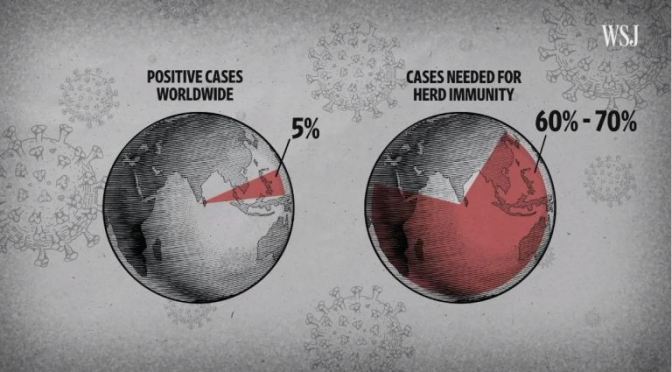
CORONAVIRUS: “HOW WE CAN REACH HERD IMMUNITY”

Scientists are working at breakneck speed to develop an effective vaccine for the coronavirus. Their ultimate goal: to immunize enough of the world’s population to reach herd immunity. WSJ explains. 

Illustration: Jacob Reynolds

HEALTH VIDEOS: “HOW CORONAVIRUSES WORK”

It’s one of the tiniest machines on the planet — about a hundred times smaller than the average cell. It’s so small that no scientist can spot it through a typical light microscope. Only with an electron microscope can we see its spiky surface. It’s not alive, and it’s not what most of us would think of as “dead.” This teensy machine seems to survive in a kind of purgatory state, yet it has traveled across continents and oceans from host to host, and brought hundreds of nations to a standstill. Despite its diminutive size, the novel coronavirus, dubbed SARS-CoV-2, has seemingly taken the world by surprise with its virulence.

HEALTH: “MAKING SENSE OF CORONAVIRUS DATA” (VIDEO)

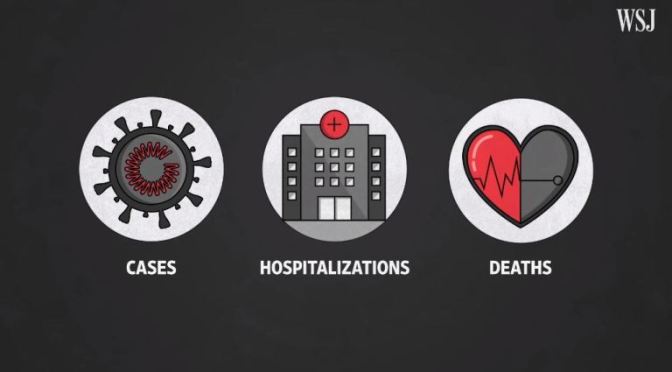
Public health organizations track the spread of coronavirus and use graphs and charts to visualize the data. WSJ’s Brianna Abbott explains what to look for in the data to understand how the virus is impacting your community.

Photo illustration: Laura Kammermann/WSJ

COVID-19 UPDATE PODCAST: HOW RESEARCHERS ARE SIMULATING OUTBREAKS

Researchers have run numerous military-style simulations to predict the consequences of fictitious viral outbreaks. We discuss how these simulations work, what recommendations come out of them and if any of these warnings have been heeded.

24:08 One good thing

Our hosts pick out things that have made them smile in the last week, including audience feedback, the official end of the Ebola outbreak in the northeastern Democratic Republic of the Congo, and an enormous t-shirt collection.

News: World’s second-deadliest Ebola outbreak ends in Democratic Republic of the Congo

28:50 The latest coronavirus research papers

Benjamin Thompson takes a look through some of the key coronavirus papers of the last few weeks.

COVID-19: “SUPERSPREADING EVENTS” – HOW THEY LEAD TO 80% OF INFECTED PEOPLE

From Scientific American (June 23, 2020):

Scientific American

In fact, research on actual cases, as well as models of the pandemic, indicate that between 10 and 20 percent of infected people are responsible for 80 percent of the coronavirus’s spread.

Researchers have identified several factors that make it easier for superspreading to happen. Some of them are environmental.

  • Poorly ventilated indoor areas seem especially conducive to the virus’s spread – A preliminary analysis of 110 COVID-19 cases in Japan found that the odds of transmitting the pathogen in a closed environment was more than 18 times greater than in an open-air space.
  • Places where large numbers of people congregate – As a group’s size increases, so does the risk of transmitting the virus to a wider cluster. A large group size also increases the chance that someone present will be infectious.
  • The longer a group stays in contact, the greater the likelihood that the virus will spread among them – The benchmark used for risk assessment in her contact-tracing work is 10 minutes of contact with an infectious person, though the CDC uses 15 minutes as a guideline.
  • Some activities seem to make it easier to spread respiratory gunk – Speech emits more particles than normal breathing. And emissions also increase as people speak louder. Singing emits even more particles, which may partially explain the superspreader event at the Washington State choir practice. Breathing hard during exercise might also help the spread of COVID-19.

Read more

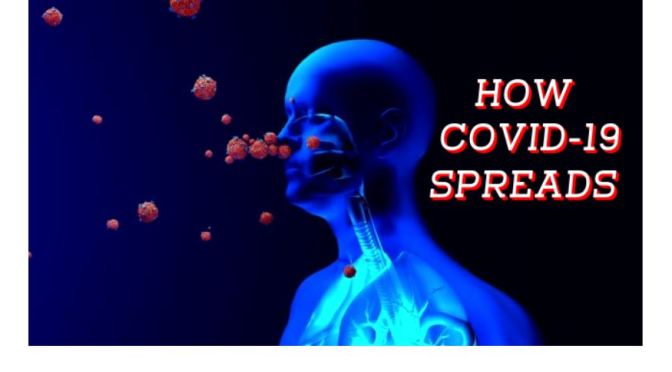
CORONAVIRUS: RESPIRATORY-DROPLET CONTACT IS MAJOR WAY COVID-19 SPREADS

From the Wall Street Journal (June 16, 2020):

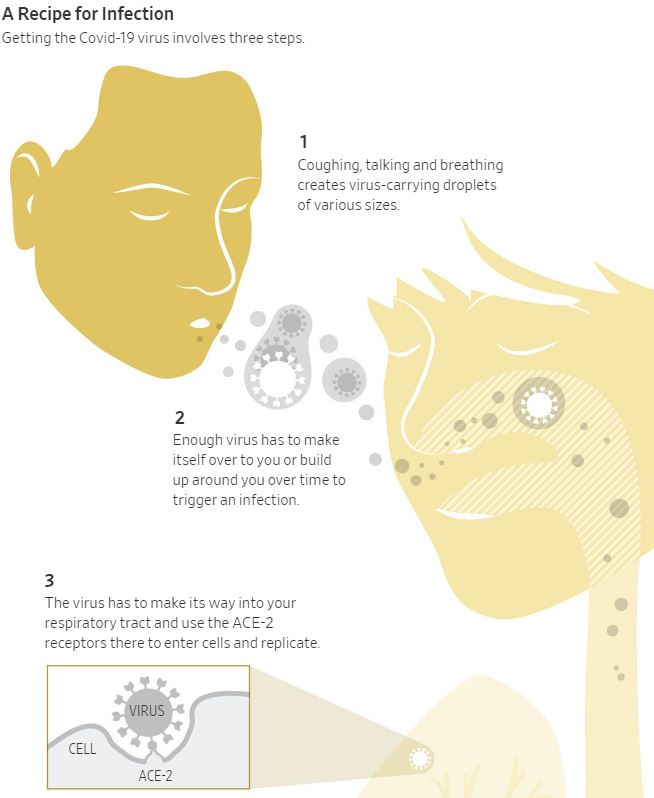
Health agencies have so far identified respiratory-droplet contact as the major mode of Covid-19 transmission. These large fluid droplets can transfer virus from one person to another if they land on the eyes, nose or mouth. But they tend to fall to the ground or on other surfaces pretty quickly.

Some researchers say the new coronavirus can also be transmitted through aerosols, or minuscule droplets that float in the air longer than large droplets. These aerosols can be directly inhaled.

Illustration: Erik Brynildsen

Sufficient ventilation in the places people visit and work is very important, said Yuguo Li, one of the authors and an engineering professor at the University of Hong Kong. Proper ventilation—such as forcing air toward the ceiling and pumping it outside, or bringing fresh air into a room—dilutes the amount of virus in a space, lowering the risk of infection.

Another factor is prolonged exposure. That’s generally defined as 15 minutes or more of unprotected contact with someone less than 6 feet away, said John Brooks, the Centers for Disease Control and Prevention’s chief medical officer for the Covid-19 response. But that is only a rule of thumb, he cautioned. It could take much less time with a sneeze in the face or other intimate contact where a lot of respiratory droplets are emitted, he said.

Read more