
TELEMEDICINE: Obstetrics & Gynecology Services

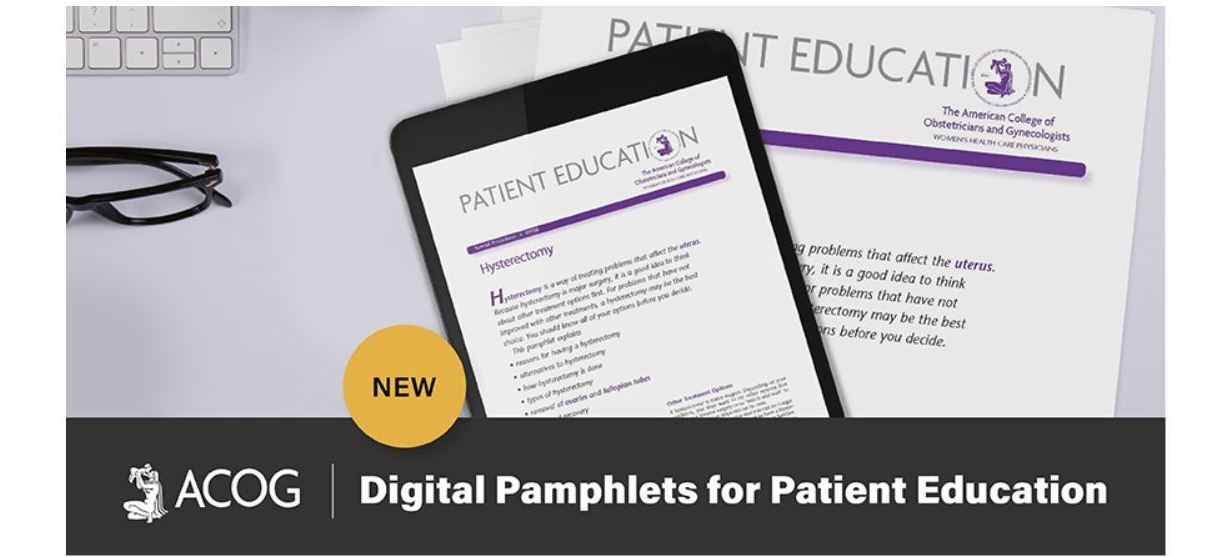
The following list contains preventive services that may be done via telehealth (from ACOG.org):

General Health

  • Alcohol screening and counseling regarding alcohol use
  • Anxiety Screening and referral*
  • Counseling regarding aspirin to prevent CVD and CRC
  • Blood pressure screening (if patient has appropriate resources available such as a blood pressure cuff)
  • Contraceptive counseling, discussion of methods, and prescribing contraceptives that do not require an in-person visit such as intrauterine devices or implants*
  • Depression screening and referral
  • Fall Prevention counseling
  • Counseling regarding folic acid supplementation
  • Healthy diet and activity counseling
  • Interpersonal and domestic violence screening and discussion of available resources*
  • Obesity screening (if patient has appropriate resources available such as a scale)
  • Substance use assessment (drug use)
  • Tobacco screening and cessation counseling
  • Urinary incontinence screening*
     

Infectious disease

  • HIV risk assessment*
  • Sexually Transmitted Infection prevention counseling*

Cancer

  • Counseling and possible prescribing of medications to reduce breast cancer risk 
  • Risk assessment for BRCA testing
  • Skin cancer counseling

Pregnancy and postpartum

  • Breastfeeding services and supplies*
  • Postpartum contraceptive counseling, discussion of methods, and  prescribing contraceptives that do not require an in-person visit such as intrauterine devices or implants
  • Depression screening and referral
  • Counseling regarding folic acid supplementation
  • Interpersonal and domestic violence screening and discussion of available resources*
  • Preeclampsia prevention with low-dose aspirin
  • Preeclampsia screening (if patient has appropriate resources available)
  • Tobacco screening and cessation counseling

*WPSI recommendation. For more information about each recommendation, please see our WPSI Recommendation page.
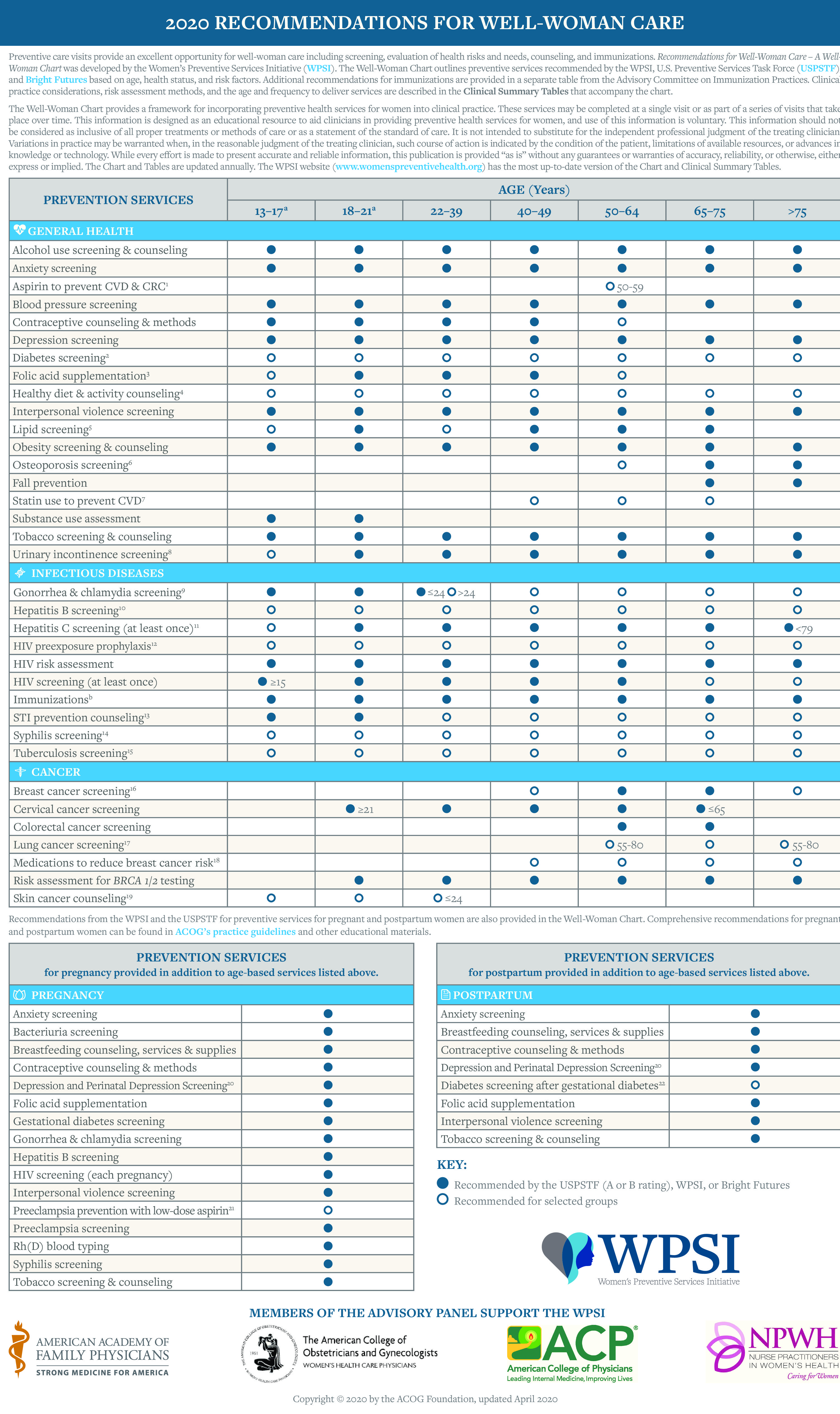
Download Well-Woman Care Chart

ACOG.org website

Read this May 4, 2020 “Women’sHealth” article for information about what a Telemedicine Visit is like

OPINION: THE IMPORTANCE OF VITAMIN D3 SUPPLEMENTS

EVERYBODY should have a SERUM VITAMIN D level!

The medical establishment has been slowly acknowledging that the importance of vitamin D is not limited to just calcium absorption and the bones, or to the athletes and elderly.The lower limits of normal has been slowly creeping up, as has the RDA.

But how much vitamin D you have in your body depends upon your diet, supplements, how much sunshine your skin gets, how much sunshine is screened out ( sunscreen, melanin), and other factors. Measuring the vitamin D serum level tells you directly.

My own Vitamin D level was at first in the low 20’s (ng./ml.), and I raised it to the low 50’s when I started taking 4,000 I.U. daily, the lower limit suggested by the NFL.

Serum Vitamin D levels cost almost $100. Why not just take 4-6,000 I.U.? For me, adding to  already nauseating handfuls of pills (to be enumerated later) was unappetizing. I needed a Serum D level to convince me.

But I didn’t need to be convinced of the importance (with hospitalized Covid Patients the VITAL importance) of this amazingly versatile Vitamin. Vitamin D tends to benefit the innate immune system, helping to ameliorate infections when they first hit. It then helps to turn off “the first responder” when the “big gun” adaptive immune system kicks in at 5-10 days. Failure of this shift ( with continuing interleukin production) may contribute to the “cytokines storm” of the seriously ill Covid-19 patient.

Many Doctors, inured to “health food industry” hype, give little attention to Vitamin D.  You might need to expressly ask for a vitamin D test on your next visit. I hope you do!

—Dr. C.

Further reading:

Vitamin D is crucial for immune health

TELEMEDICINE: CHECKLIST – DERMATOLOGIST SESSIONS

According to the American Academy of Dermatology, “The technology has reached a point where, in many situations, health care providers can use IT to offer quality health care services remotely,” and they support telemedicine as an additional treatment tool to supplement in-person services.

To get the most from your telemedicine appointment, board-certified dermatologists offer these tips:

  1. Contact your insurance provider to find out if your plan covers telemedicine appointments. Many insurance providers are updating their plans to cover telemedicine visits during the coronavirus pandemic. Find out what type of telemedicine visits are covered by your insurance.
  2. Gather essential information. This is especially important if you have a telemedicine appointment with a dermatologist you haven’t seen before. Knowing your medical history will help your dermatologist make a diagnosis, decide treatment options, and prescribe medicine, if necessary. Ask your dermatologist’s office if they have any forms you need to fill out before your appointment.Before your appointment, make a list of the following:
    • Medications you take
    • Major illnesses or surgeries you have had
    • Previous skin problems
    • When your current symptoms began
    • Your allergies
    • Illnesses that your family members have had, such as cancer, heart disease, or diabetes
  3. Find out how to reach your dermatologist. Talk to your dermatologist’s office to make sure you know what type of telemedicine appointment you will have, and how your dermatologist will reach out to you. Ask when and how to send the pictures and information you gather.
    • For video visits, you will be sent a website link you can use to connect with your dermatologist at the time of your appointment.
    • For telephone visits, you may be given instructions on when to expect a call from your dermatologist.
    • undefined
  4. Write down all your questions. Doing this helps you remember everything you plan to talk to your dermatologist about and make the most of your appointment.
  5. Take pictures. To help your dermatologist examine your concern, take clear pictures of the areas you need examined. Follow these tips to make sure the pictures are the highest-possible quality:
    • Make sure your pictures are well-lit. Take your pictures in natural light, if possible. Use another light source, like a book light or flashlight, if needed. Make sure that there aren’t any shadows or glares on the area you are taking pictures of.
    • Take multiple pictures, including one of each side of the area you need examined. Make sure to show the entire area around your spot or rash. If your spot is hard to see, you may want circle it or draw an arrow pointing toward it with a marker.
    • Take pictures to compare. For example, if you have a spot on your hand, take pictures of both hands so your dermatologist can see how that area usually looks. Make sure you also take a close-up and a far-away picture of the areas you are concerned about so your dermatologist can compare.
    • Just like an in-person dermatologist appointment, do not wear makeup. If you need your nails examined, take off any nail polish you have on before taking any pictures.
    • Get help. If you live with someone, ask them to take pictures of hard-to-reach areas, such as your back. If you live alone, use a mirror to make sure you are taking pictures of the right spot.
    • If your picture turns out blurry, delete it and replace it with one that is clearer.
  6. Avoid irritating your skin before your appointment. Try to avoid doing things that could change the appearance of your skin before you begin your telemedicine appointment or take your pictures. Some examples of things to avoid are taking a hot shower, rubbing or picking at your skin, or applying skin care products.
  7. Find a private space. Find a quiet and private space without distractions to have your appointment. Make sure you can connect to the internet in that space and it has the best-possible lighting.

For more information

GERIATRIC TELEMEDICINE: NEW CONNECTIVITY AND CONVENIENCE AT HOME

From Becker’s Hospital Review (May 1, 2020):

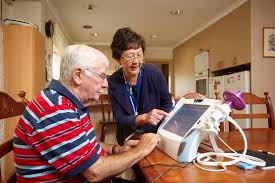
Connectivity in combination with mobile devices is making home-based services like telepharmacy and telemedicine a reality. These are great options if patients feel too sick to leave their home or they want a second opinion. It’s also possible to connect people in rural areas with academic medical centers. During the pandemic, the use of telemedicine has risen dramatically.

“Technology is enabling access to healthcare in many ways,” Holcomb said. “You no longer need to live in certain places to get access to great care, and you no longer have to go to your physician in person, for many aspects of a visit – this is helping people get care, even as they stay at home.”

Against the backdrop of the aging population and ongoing pandemic, technology is likely to continue to influence healthcare consumer expectations. Almost every aspect of life has been transformed by the emergence of digital conveniences. Digital technology is transforming industries, including shopping, communications and entertainment. Healthcare is no exception.

Read full article

Howard Fillit, MD: The Positives of Telemedicine Adoption for Geriatric Patients

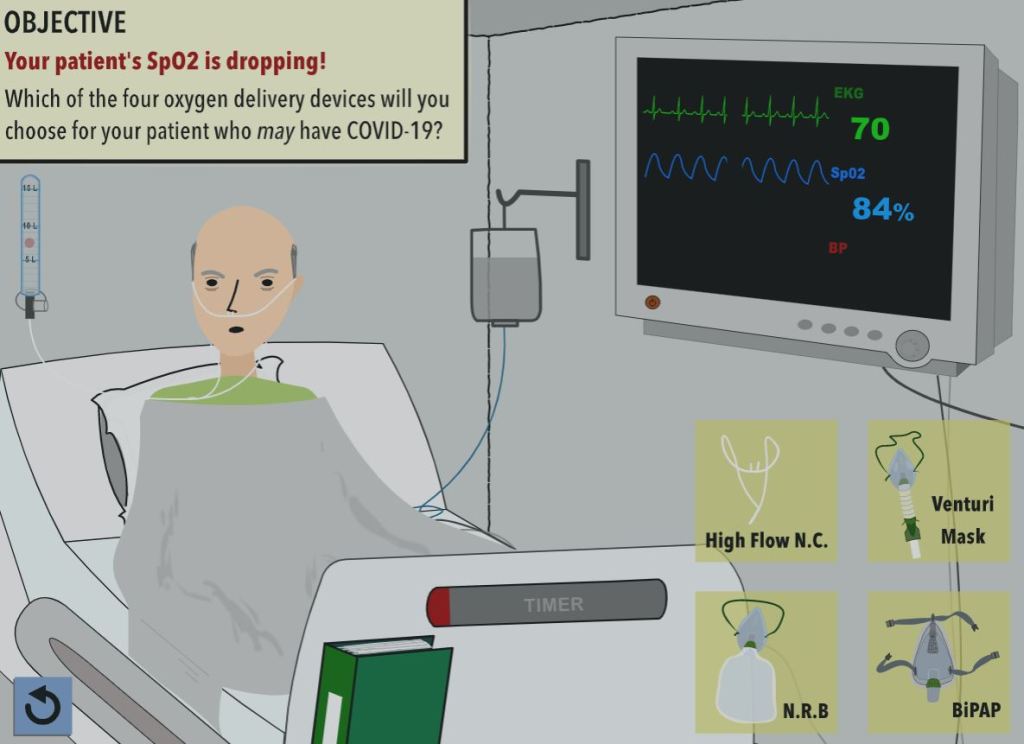
PHYSICIAN’S CORNER: NEJM “COVID-19 PRIMER – VIRTUAL PATIENT SIMULATION” (2020)

CLICK ON PATIENT BELOW TO LAUNCH “VIRTUAL PATIENT SIMULATION”

COMMENTARY

This interactive simulated case of Covid 19 (SARS CoV-2) is remarkable: a unique opportunity to stand in the shoes of a ER Doctor without any risk, except to our egos.

This is meant for doctors, but the intellectually curious  Guests of this site might enjoy the experience, especially Doctor Lisa Sanders fans.
The vocabulary is full Medical, and will give a foretaste of the words I will slowly be exploring. I believe that patients should not be intimidated by their lab reports.

I’ll start the vocabulary journey with FERRITIN which is a marker for IRON STORES in the body. You can have too much iron, which is dangerous (iron overload), in which case the ferritin is high.

There was a time when I had too little iron ( was anemic, with a hemoglobin of 8.6, and felt terrible) and my ferritin was low. I now check my ferritin every 6 months to make sure I am taking enough iron to offset my blood loss, which is another story I will tell when I start go through my medicine cabinet and discuss the Meds one at a time.

The reason for testing ferritin in our interactive Covid 19 case was because ferritin is markedly elevated in cases of inflammation/ infection. It is an “acute phase reactant”, and may reflect the “cytokines storm” that may be a contributor to the lethality of Covid 19.

There is another way to benefit from this simulation: the train-wreck of a patient serves as a cautionary tale of what you wish NOT to become. Our present medical profession is so DISEASE oriented. How much better if our society and our medical profession were HEALTH oriented instead.

—Dr. C.

CORONAVIRUS PODCAST: TRACING APPS, Antiviral remdesivir’S PROMISE

The Coronapod team pick through the latest news, plus we hear from the researchers making lemonade out of lockdown lemons.

In this episode:

01:10 Can contact-tracing apps help?

Governments around the world are banking on smartphone apps to help end the spread of the coronavirus. But how effective might these apps might be? What are the risks? And how should they fit into wider public health strategies?

Editorial: Show evidence that apps for COVID-19 contact-tracing are secure and effective

13:30 Antiviral remdesivir shows promise

Early results from a US trial of the antiviral drug remdesivir suggest it shortens recovery time for patients with COVID-19. We unpick the findings.

News: Hopes rise for coronavirus drug remdesivir

16:52 One good thing

Our hosts pick out things that have made them smile in the last week, including blooming trust in scientists, cooking experiments, and a neighbourhood coming together to clap for healthcare workers.

21:34 Unexpected opportunities

We hear from three researchers making the most of lockdown, studying tiny earthquakes, building balcony-based citizen science projects, or enlisting gamers to fight the coronavirus.

Fold-it, the protein-folding computer game

TELEMEDICINE: 80% OF PEDIATRIC PATIENTS SEEN REMOTELY AT JOHNS HOPKINS CHILDREN’S CENTER

From Johns Hopkins Medicine (April 30, 2020):

“A lot of our pediatric divisions are now seeing 80% or more of their patients by video or telephone,” says Hughes.

The Children’s Center’s preparations for the virus and the disease it causes, COVID-19, were unwittingly sparked by pediatrician Helen Hughes and her early work in telemedicine outreach for pediatric subspecialists. In 2018, she spearheaded development of a telemedicine collaboration with the Talbot County Health Department on Maryland’s Eastern Shore.

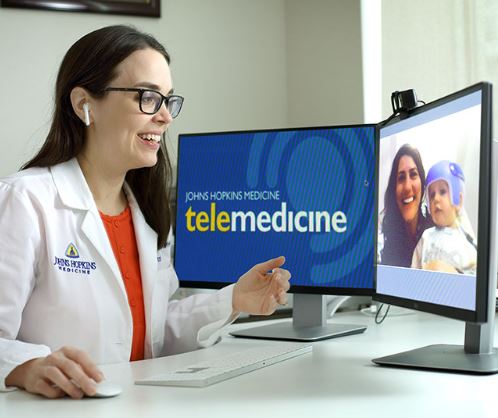
Pediatrician Helen Hughes during a video visit with a young patient and mom.. Johns Hopkins Medicine

The goal was to ease the burden of long treks to Johns Hopkins’ Baltimore campus for young patients — especially medically complex patients — for follow-up visits. At the time, she said, “This is where the future of health care is headed. Video technologies can allow us to do so many things for our patients without having to see them in person every time.”

The Children’s Center, notes Hughes, had been conducting between zero and eight video visits per month for the past two years. In the second half of March, after the coronavirus had clearly arrived, Johns Hopkins pediatricians and pediatric subspecialists saw 800 patients via telemedicine. That number increased to 1,400 telemedicine visits in the first half of April. Additionally, MyChart users in April jumped to 71%.

Read full article

TELEMEDICINE: “FORWARD TRIAGE” FOR SCREENING PATIENTS DURING COVID-19

 Direct-to-consumer (or on-demand) telemedicine, a 21st-century approach to forward triage that allows patients to be efficiently screened, is both patient-centered and conducive to self-quarantine, and it protects patients, clinicians, and the community from exposure.

Interview with Dr. Judd Hollander on how health systems can use telemedicine services during the Covid-19 pandemic.

It can allow physicians and patients to communicate 24/7, using smartphones or webcam-enabled computers. Respiratory symptoms — which may be early signs of Covid-19 — are among the conditions most commonly evaluated with this approach. 

Health care providers can easily obtain detailed travel and exposure histories. Automated screening algorithms can be built into the intake process, and local epidemiologic information can be used to standardize screening and practice patterns across providers.

Disasters and pandemics pose unique challenges to health care delivery. Though telehealth will not solve them all, it’s well suited for scenarios in which infrastructure remains intact and clinicians are available to see patients. Payment and regulatory structures, state licensing, credentialing across hospitals, and program implementation all take time to work through, but health systems that have already invested in telemedicine are well positioned to ensure that patients with Covid-19 receive the care they need. In this instance, it may be a virtually perfect solution.

Read full article at NEJM

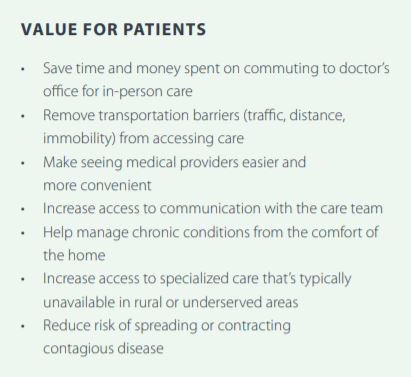
TELEMEDICINE: “THE MOST COMMON USES AND HIGHEST VALUE FOR PATIENTS”

Telehealth had been gaining momentum in recent years, but the COVID-19 pandemic is propelling physician practices to quickly figure out how they can best use the technology to provide patients with care while practicing physical distancing.

(From an AMA article -April 29, 2020)

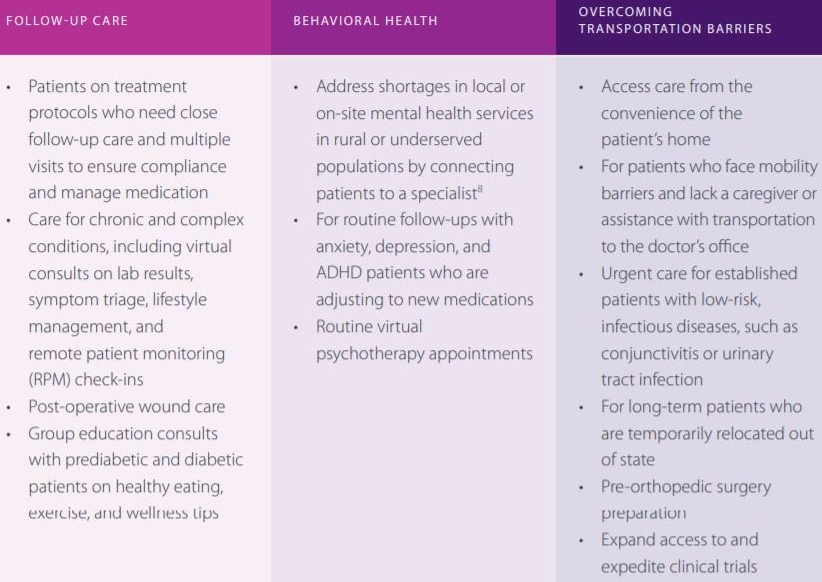
COMMON USES FOR TELEHEALTH INCLUDE:

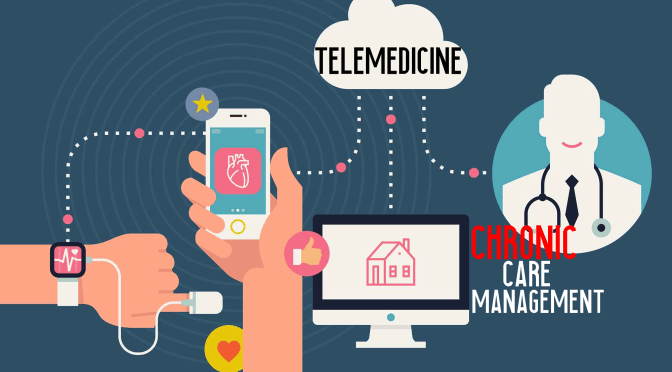
VIRTUAL HEALTH: “CHRONIC CARE MANAGEMENT” PROVES VALUE OF TELEMEDICINE

From a ComputerWorld article (April 27, 2020):

While the pandemic will prove the value of virtual care in a crisis, it will also demonstrate the effectiveness for ongoing chronic care management,” she said. “This moment will have a lasting effect on the adoption of virtual care and accelerate the shift from in-person care to virtual first engagement for multiple conditions and use cases.”

While the need for remote care will not be as acute once the pandemic crisis subsides, demand for telehealth systems will likely remain high. Forrester now expects more than one billion virtual care visits this year, the vast majority of them related to COVID-19.

“…After the crisis subsides, there will be a patient population that will want to continue to receive care online for some things, like managing chronic conditions, follow-up visits after an inpatient stay, surgery or to discuss diagnostic results,” she said.

In this case, it will be important for healthcare providers to ensure that patients are aware of the availability of services.

Read full article