
Tag Archives: Patients

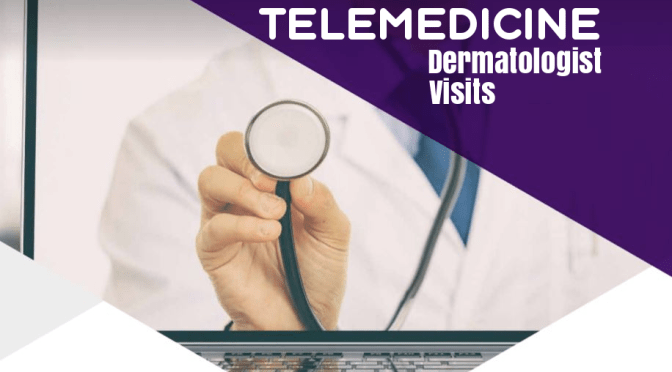
TELEMEDICINE: CHECKLIST – DERMATOLOGIST SESSIONS

According to the American Academy of Dermatology, “The technology has reached a point where, in many situations, health care providers can use IT to offer quality health care services remotely,” and they support telemedicine as an additional treatment tool to supplement in-person services.

To get the most from your telemedicine appointment, board-certified dermatologists offer these tips:

  1. Contact your insurance provider to find out if your plan covers telemedicine appointments. Many insurance providers are updating their plans to cover telemedicine visits during the coronavirus pandemic. Find out what type of telemedicine visits are covered by your insurance.
  2. Gather essential information. This is especially important if you have a telemedicine appointment with a dermatologist you haven’t seen before. Knowing your medical history will help your dermatologist make a diagnosis, decide treatment options, and prescribe medicine, if necessary. Ask your dermatologist’s office if they have any forms you need to fill out before your appointment.Before your appointment, make a list of the following:
    • Medications you take
    • Major illnesses or surgeries you have had
    • Previous skin problems
    • When your current symptoms began
    • Your allergies
    • Illnesses that your family members have had, such as cancer, heart disease, or diabetes
  3. Find out how to reach your dermatologist. Talk to your dermatologist’s office to make sure you know what type of telemedicine appointment you will have, and how your dermatologist will reach out to you. Ask when and how to send the pictures and information you gather.
    • For video visits, you will be sent a website link you can use to connect with your dermatologist at the time of your appointment.
    • For telephone visits, you may be given instructions on when to expect a call from your dermatologist.

    • undefined
  4. Write down all your questions. Doing this helps you remember everything you plan to talk to your dermatologist about and make the most of your appointment.
  5. Take pictures. To help your dermatologist examine your concern, take clear pictures of the areas you need examined. Follow these tips to make sure the pictures are the highest-possible quality:
    • Make sure your pictures are well-lit. Take your pictures in natural light, if possible. Use another light source, like a book light or flashlight, if needed. Make sure that there aren’t any shadows or glares on the area you are taking pictures of.
    • Take multiple pictures, including one of each side of the area you need examined. Make sure to show the entire area around your spot or rash. If your spot is hard to see, you may want circle it or draw an arrow pointing toward it with a marker.
    • Take pictures to compare. For example, if you have a spot on your hand, take pictures of both hands so your dermatologist can see how that area usually looks. Make sure you also take a close-up and a far-away picture of the areas you are concerned about so your dermatologist can compare.
    • Just like an in-person dermatologist appointment, do not wear makeup. If you need your nails examined, take off any nail polish you have on before taking any pictures.
    • Get help. If you live with someone, ask them to take pictures of hard-to-reach areas, such as your back. If you live alone, use a mirror to make sure you are taking pictures of the right spot.
    • If your picture turns out blurry, delete it and replace it with one that is clearer.
  6. Avoid irritating your skin before your appointment. Try to avoid doing things that could change the appearance of your skin before you begin your telemedicine appointment or take your pictures. Some examples of things to avoid are taking a hot shower, rubbing or picking at your skin, or applying skin care products.
  7. Find a private space. Find a quiet and private space without distractions to have your appointment. Make sure you can connect to the internet in that space and it has the best-possible lighting.


For more information

GERIATRIC TELEMEDICINE: NEW CONNECTIVITY AND CONVENIENCE AT HOME

From Becker’s Hospital Review (May 1, 2020):

Connectivity in combination with mobile devices is making home-based services like telepharmacy and telemedicine a reality. These are great options if patients feel too sick to leave their home or they want a second opinion. It’s also possible to connect people in rural areas with academic medical centers. During the pandemic, the use of telemedicine has risen dramatically.

“Technology is enabling access to healthcare in many ways,” Holcomb said. “You no longer need to live in certain places to get access to great care, and you no longer have to go to your physician in person, for many aspects of a visit – this is helping people get care, even as they stay at home.”

Against the backdrop of the aging population and ongoing pandemic, technology is likely to continue to influence healthcare consumer expectations. Almost every aspect of life has been transformed by the emergence of digital conveniences. Digital technology is transforming industries, including shopping, communications and entertainment. Healthcare is no exception.

Read full article

Howard Fillit, MD: The Positives of Telemedicine Adoption for Geriatric Patients

TELEMEDICINE: “FORWARD TRIAGE” FOR SCREENING PATIENTS DURING COVID-19

 Direct-to-consumer (or on-demand) telemedicine, a 21st-century approach to forward triage that allows patients to be efficiently screened, is both patient-centered and conducive to self-quarantine, and it protects patients, clinicians, and the community from exposure.

Interview with Dr. Judd Hollander on how health systems can use telemedicine services during the Covid-19 pandemic.

It can allow physicians and patients to communicate 24/7, using smartphones or webcam-enabled computers. Respiratory symptoms — which may be early signs of Covid-19 — are among the conditions most commonly evaluated with this approach. 

Health care providers can easily obtain detailed travel and exposure histories. Automated screening algorithms can be built into the intake process, and local epidemiologic information can be used to standardize screening and practice patterns across providers.

Disasters and pandemics pose unique challenges to health care delivery. Though telehealth will not solve them all, it’s well suited for scenarios in which infrastructure remains intact and clinicians are available to see patients. Payment and regulatory structures, state licensing, credentialing across hospitals, and program implementation all take time to work through, but health systems that have already invested in telemedicine are well positioned to ensure that patients with Covid-19 receive the care they need. In this instance, it may be a virtually perfect solution.

Read full article at NEJM

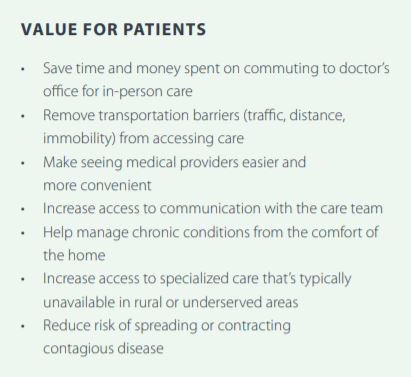
TELEMEDICINE: “THE MOST COMMON USES AND HIGHEST VALUE FOR PATIENTS”

Telehealth had been gaining momentum in recent years, but the COVID-19 pandemic is propelling physician practices to quickly figure out how they can best use the technology to provide patients with care while practicing physical distancing.

(From an AMA article -April 29, 2020)

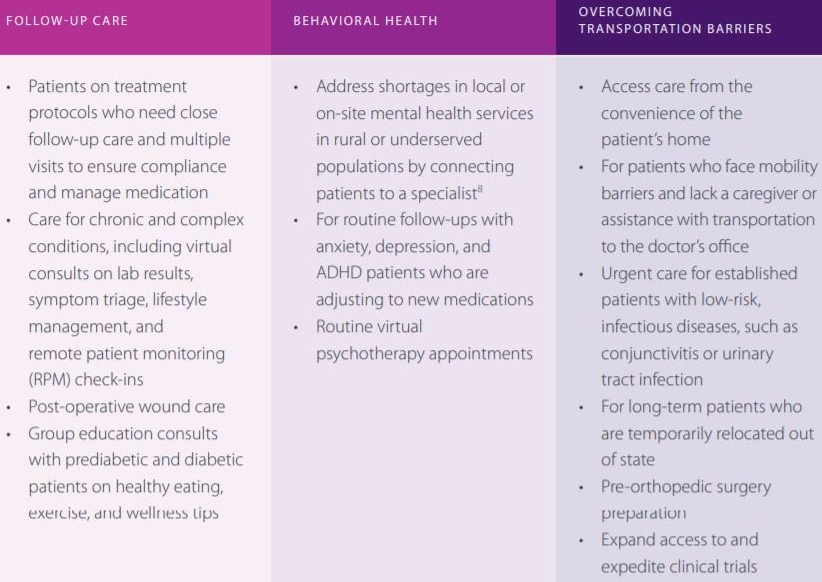
COMMON USES FOR TELEHEALTH INCLUDE:

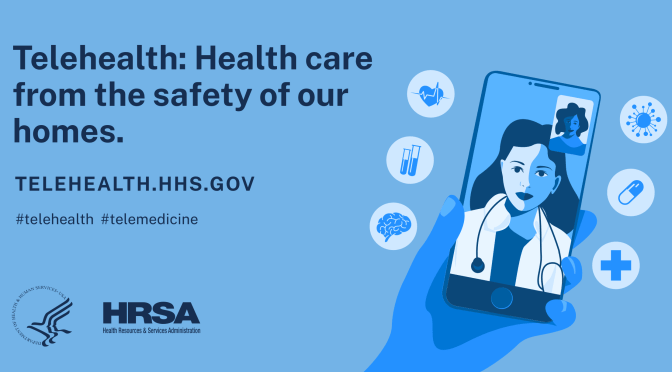
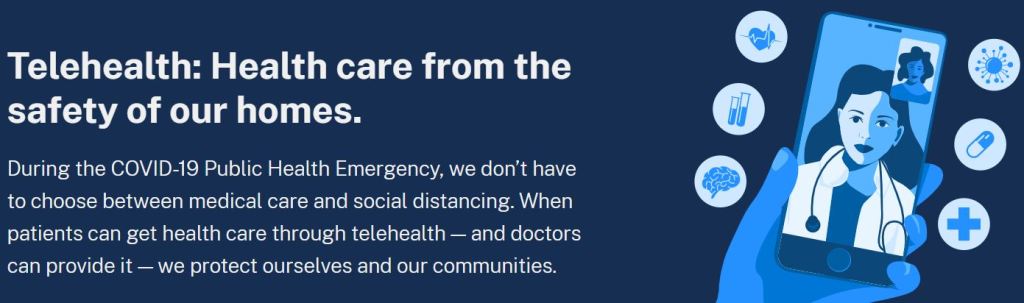
HHS Website: “Telehealth – Health Care From The Safety Of Our Homes”

For patients

Wondering how to get started with telehealth? Check out the information below to better understand your options.

Patient standing and looking at a huge phone screen (larger than life) that has a doctor inside of it. Waving to each other.

Finding telehealth options

If screening tools and self-checkers do not lead you to the care or information you are seeking, you can reach out directly to your doctor or health insurance company for options that can help connect you to a provider online. Understanding telehealth

Find out what it is, what to expect during a visit, and what kinds of care may be available. Telehealth during the COVID-19 emergency

Whether you’re looking for health care related to COVID-19 or something else, find out more about how to prepare for the visit. Preparing for a video visit

WEBSITE

TELEMEDICINE: TRANSITION TO WIDESPREAD ADOPTION

APRIL 8, 2020

Until recently, there were several barriers preventing widespread adoption of telemedicine. The two broad themes were:

  1. Providers, health systems, and payers were slow to embrace change
  2. A failure to appreciate that telemedicine is not a new type of medicine, but rather simply a care delivery mechanism that can be utilized with some patients, some of the time, to provide high-quality care

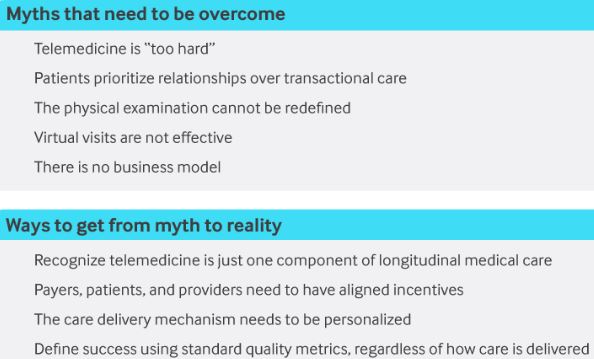
Addressing the Telemedicine Myths

Myth 1: Telemedicine is “too hard.”

This was not true before Covid-19 and we have further demonstrated that it is not true now. Almost every provider and the great majority of patients in the U.S. already possess the technology needed to conduct a telemedicine visit — a smartphone, tablet, or computer. 

It turns out that when fear of catching a potentially fatal disease strikes, telemedicine is no longer too hard.

Myth 2: Patients prioritize existing relationships with their provider over transactional episodic care.

Data argues otherwise: The majority of times, patients just want care. Falling primary care visits rates, coupled with growing emergency department and urgent care visit rates, suggests convenience as more important than an established relationship.

Myth 3. You cannot do a physical examination.

It turns out you can. A new 21st-century physical exam utilizing telemedicine emphasizes the importance of general appearance (sick or not sick, weight, distress), respiratory effort, and environmental factors including a visual assessment of the home that is not something that can be accomplished at an office visit. 

The majority of times, patients just want care.

Myth 4: Virtual visits are less effective than in-person visits.

Focusing on the comparison in diagnostic accuracy between virtual and in-person visits sets up a false dichotomy. Focusing on actionable information is more important than diagnostic accuracy.2 Actionable information recognizes providers might not always make a diagnosis within a single visit, whether in-person or telemedicine. 

Like every other new challenge, you have to try telemedicine to get comfortable with it.

Myth 5. There is not a payment model supporting telemedicine.

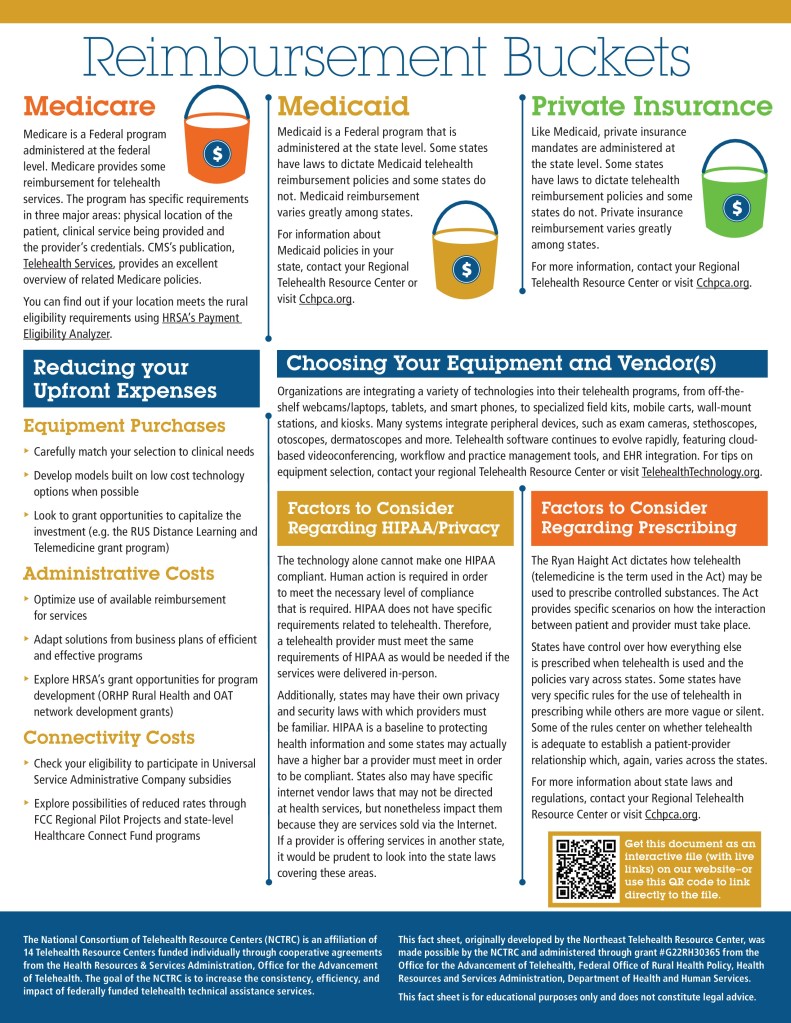
While it is true that the Centers for Medicare & Medicaid Services (pre-Covid-19) had limited reimbursement based upon site of service and geography, since the Covid-19 outbreak, to the credit of the federal government and commercial payers, telemedicine is now covered.

Read full article