If screening tools and self-checkers do not lead you to the care or information you are seeking, you can reach out directly to your doctor or health insurance company for options that can help connect you to a provider online. Understanding telehealth
Whether you’re looking for health care related to COVID-19 or something else, find out more about how to prepare for the visit. Preparing for a video visit
Until recently, there were several barriers preventing widespread adoption of telemedicine. The two broad themes were:
Providers, health systems, and payers were slow to embrace change
A failure to appreciate that telemedicine is not a new type of medicine, but rather simply a care delivery mechanism that can be utilized with some patients, some of the time, to provide high-quality care
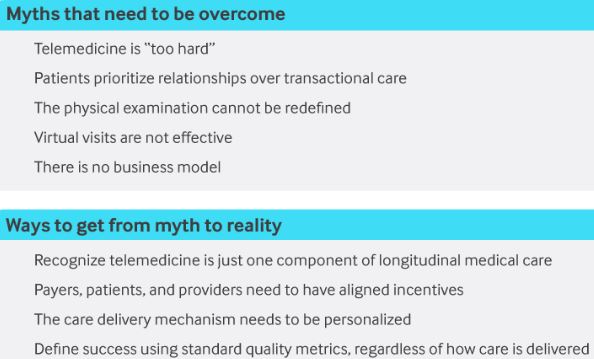
Addressing the Telemedicine Myths
Myth 1: Telemedicine is “too hard.”
This was not true before Covid-19 and we have further demonstrated that it is not true now. Almost every provider and the great majority of patients in the U.S. already possess the technology needed to conduct a telemedicine visit — a smartphone, tablet, or computer.
It turns out that when fear of catching a potentially fatal disease strikes, telemedicine is no longer too hard.
Myth 2: Patients prioritize existing relationships with their provider over transactional episodic care.
Data argues otherwise: The majority of times, patients just want care. Falling primary care visits rates, coupled with growing emergency department and urgent care visit rates, suggests convenience as more important than an established relationship.
Myth 3. You cannot do a physical examination.
It turns out you can. A new 21st-century physical exam utilizing telemedicine emphasizes the importance of general appearance (sick or not sick, weight, distress), respiratory effort, and environmental factors including a visual assessment of the home that is not something that can be accomplished at an office visit.
The majority of times, patients just want care.
Myth 4: Virtual visits are less effective than in-person visits.
Focusing on the comparison in diagnostic accuracy between virtual and in-person visits sets up a false dichotomy. Focusing on actionable information is more important than diagnostic accuracy.2 Actionable information recognizes providers might not always make a diagnosis within a single visit, whether in-person or telemedicine.
Like every other new challenge, you have to try telemedicine to get comfortable with it.
Myth 5. There is not a payment model supporting telemedicine.
While it is true that the Centers for Medicare & Medicaid Services (pre-Covid-19) had limited reimbursement based upon site of service and geography, since the Covid-19 outbreak, to the credit of the federal government and commercial payers, telemedicine is now covered.
In the current times that we live in health care professionals are looking for ways to provide safe, quality care from a distance. Telehealth and Digital health are proving to be the perfect tools during this COVID-19 pandemic.
PART I
In today’s episode Part I, we are joined with Dr. Amit Sachdev and Dr. Curtis Lowery. Dr. Sachdev is a physician most recently at the Brigham and Women’s Hospital, Harvard Medical School and he is currently working on the COVID response.
Dr. Curtis Lowery is the director of the UAMS Institute for Digital Health and Innovation. He also serves as a professor for the UAMS Department of Obstetrics and Gynecology. This episode is in two parts and it serves as an introduction to telehealth and digital health amidst the COVID-19 pandemic.
PART II
In part 2 of our conversation with Dr. Amit Sachdev and Dr. Curtis Lowery over the usefulness of telehealth and digital health during the COVID-19 pandemic. Dr. Sachdev is a physician most recently at the Brigham and Women’s Hospital, Harvard Medical School and he is currently working on the COVID response. Dr. Curtis Lowery is the director of the UAMS Institute for Digital Health and Innovation. He also serves as a professor for the UAMS Department of Obstetrics and Gynecology. Let’s continue the conversation.
The BMJ’s new podcast aims to help doctors feel more connected, heard, and supported
“Deep breath in … and out. Again, deep breath in … and out.”
We tune in to patients’ breath sounds, seeking confirmation of a diagnosis—one more supporting piece of evidence to reassure anxious patients or to narrow the differential.
But since the SARS-CoV-2 pandemic arrived, saying “deep breath in” has been replaced by the need to take one ourselves: before looking at the morning news, before venturing out (or logging on) to work each morning, and before ringing the next patient on your list with the ominous note alongside their name: “fever and cough for a week, now feeling breathless.” Although chosen in what seems like a different era, the name for The BMJ’s new podcast for general practitioners—Deep Breath In—seems fitting for our troubled times.
Rebooting general practice
Before anyone in Wuhan fell ill, GPs had already been feeling the strain. In the UK, despite government promises of 5000 new practising GPs by 2020, there were 6.2% fewer full time equivalent GPs in 2019 than in 2015.1 Similarly, physicians in the US have been compensating for an estimated shortfall of some 14 500 primary care doctors since 2017.2 Recent attempts to take the strain off GPs in England by funding allied health professionals have faltered because of onerous new demands on fledgling primary care networks.3 Turning it off and switching it back on again is often the only thing that works when your computer grinds to a halt. Perhaps coronavirus will do the same for primary care.
Primary Care Physicians are a vanishing species [1]. This is unfortunate, since PCPs are the only doctors who attend the whole field of Medicine (have you ever asked an orthopedist about your cough?).
However, some of the slack is being taken up by Nurse Practitioners [2] and Physicians Assistants [3].
If you know a retired Internist or Family Practice Physician, be sure to cultivate a friendly relationship (and give them a hug when the Covid 19 epidemic cools off). They might be inclined to be that greatest of all Medical Resources- the Patient Advocate [4].
—Dr. C.
Empowering Patients Through Education And Telemedicine



 Doctors Without Waiting Rooms