
Wondering how to get started with telehealth? Check out the information below to better understand your options.

If screening tools and self-checkers do not lead you to the care or information you are seeking, you can reach out directly to your doctor or health insurance company for options that can help connect you to a provider online. Understanding telehealth
Find out what it is, what to expect during a visit, and what kinds of care may be available. Telehealth during the COVID-19 emergency
Whether you’re looking for health care related to COVID-19 or something else, find out more about how to prepare for the visit. Preparing for a video visit

Until recently, there were several barriers preventing widespread adoption of telemedicine. The two broad themes were:
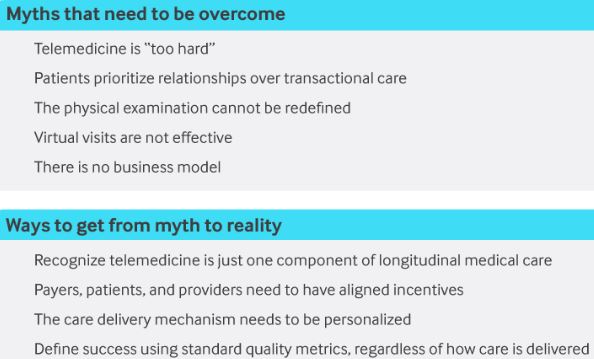
This was not true before Covid-19 and we have further demonstrated that it is not true now. Almost every provider and the great majority of patients in the U.S. already possess the technology needed to conduct a telemedicine visit — a smartphone, tablet, or computer.
It turns out that when fear of catching a potentially fatal disease strikes, telemedicine is no longer too hard.
Data argues otherwise: The majority of times, patients just want care. Falling primary care visits rates, coupled with growing emergency department and urgent care visit rates, suggests convenience as more important than an established relationship.
It turns out you can. A new 21st-century physical exam utilizing telemedicine emphasizes the importance of general appearance (sick or not sick, weight, distress), respiratory effort, and environmental factors including a visual assessment of the home that is not something that can be accomplished at an office visit.
The majority of times, patients just want care.
Focusing on the comparison in diagnostic accuracy between virtual and in-person visits sets up a false dichotomy. Focusing on actionable information is more important than diagnostic accuracy.2 Actionable information recognizes providers might not always make a diagnosis within a single visit, whether in-person or telemedicine.
Like every other new challenge, you have to try telemedicine to get comfortable with it.
While it is true that the Centers for Medicare & Medicaid Services (pre-Covid-19) had limited reimbursement based upon site of service and geography, since the Covid-19 outbreak, to the credit of the federal government and commercial payers, telemedicine is now covered.
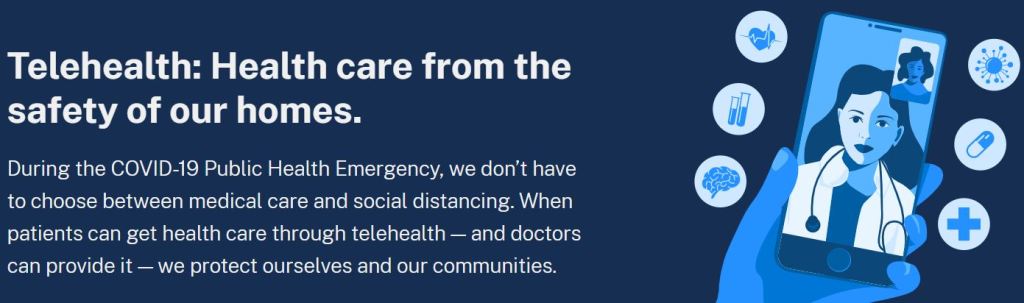
In the current times that we live in health care professionals are looking for ways to provide safe, quality care from a distance. Telehealth and Digital health are proving to be the perfect tools during this COVID-19 pandemic.
PART I
In today’s episode Part I, we are joined with Dr. Amit Sachdev and Dr. Curtis Lowery. Dr. Sachdev is a physician most recently at the Brigham and Women’s Hospital, Harvard Medical School and he is currently working on the COVID response.
Dr. Curtis Lowery is the director of the UAMS Institute for Digital Health and Innovation. He also serves as a professor for the UAMS Department of Obstetrics and Gynecology. This episode is in two parts and it serves as an introduction to telehealth and digital health amidst the COVID-19 pandemic.
PART II
In part 2 of our conversation with Dr. Amit Sachdev and Dr. Curtis Lowery over the usefulness of telehealth and digital health during the COVID-19 pandemic. Dr. Sachdev is a physician most recently at the Brigham and Women’s Hospital, Harvard Medical School and he is currently working on the COVID response. Dr. Curtis Lowery is the director of the UAMS Institute for Digital Health and Innovation. He also serves as a professor for the UAMS Department of Obstetrics and Gynecology. Let’s continue the conversation.

 Doctors Without Waiting Rooms