Annual low-dose CT scans are now recommended for smokers with 20 pack years, who are over 50 years of age and have stopped smoking within the past 15 years.
The screening test is progressively becoming more advisable because of improvements in technology, such as endoscopic biopsy, and improved criteria to prevent overtreating false positives.
The advantage of the test is that cancer can often be caught early, at which time 60% is curable, compared to only 7% five-year survival if the disease has spread.
It’s startling to realize how a few people take advantage of this test, currently averaging only 6%. Family practitioners have been slow to embrace this valuable preventative screening, and the American Lung association has increased It’s outreach to doctors and patients alike.
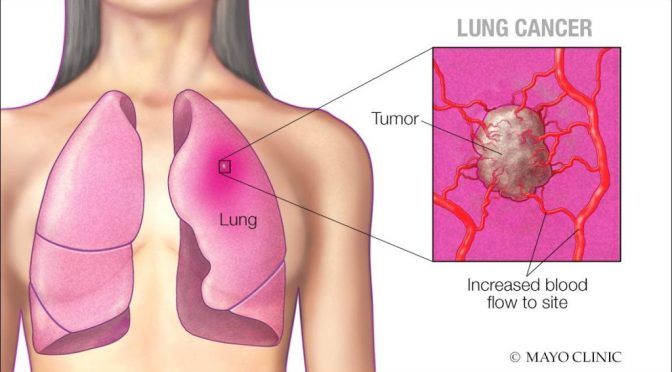
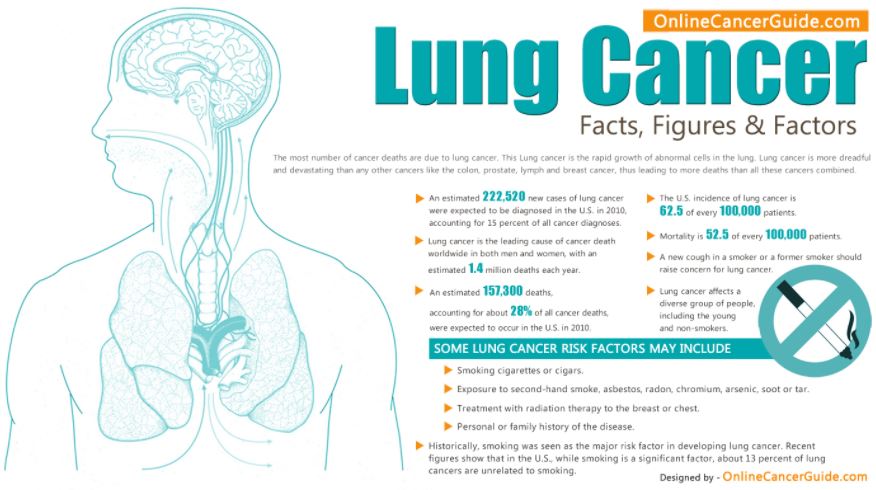
Lung cancer is still the nations top cancer threat, killing upwards of 127,000 people in the United States each year, although the toll has lessened recently thanks to the declining smoking rates and new treatments.
Yale Medicine (February 11, 2023) – Robotic bronchoscopy, also known as robotic-assisted bronchoscopy, is a recent advancement in bronchoscopy, the procedure used to biopsy lung nodules to detect the presence of lung cancer and other lung diseases. Lung cancer is the third most common type of cancer and the leading cause of cancer-related death in the United States.
Early diagnosis and treatment often lead to better outcomes. A diagnosis of lung cancer often begins when a chest X-ray or computed tomography (CT) scan shows a nodule—an area of abnormal tissue—in the lungs. If the nodule is suspicious or grows over time, doctors will perform a biopsy to collect a tissue sample that can be tested for the presence of cancer cells. Bronchoscopy is a widely used procedure for biopsying lung nodules.
In traditional bronchoscopy, a doctor manually guides a thin tube, called a bronchoscope, into the patient’s mouth or nose, down the throat, past the vocal cords and windpipe, and into the passageways of the lungs. The bronchoscope is equipped with a light, camera, and biopsy tools that allow doctors to visually examine and biopsy nodules. But robotic bronchoscopy is different. Like traditional bronchoscopy, it’s a minimally invasive procedure that allows doctors to biopsy nodules in the lungs.
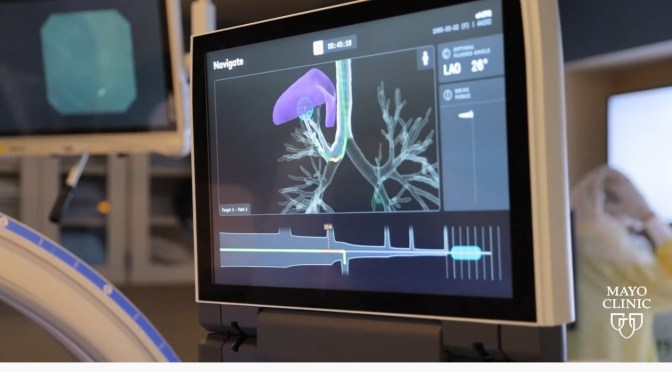
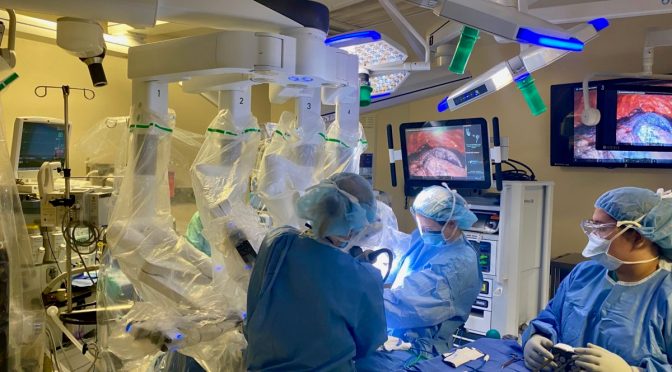
The difference is that in robotic bronchoscopy, the doctor uses a controller at a console to operate a robotic arm. The robotic arm guides a catheter—a thin, flexible, and maneuverable tube equipped with a camera, light, and shape-sensing technology—through the patient’s airways. The robotic arm’s precise movements enable doctors to accurately direct the catheter around tight turns in the airways and into the hard-to-reach areas of the lungs. This means doctors can examine and biopsy suspicious nodules—and potentially detect cancer—in parts of the lungs that may be inaccessible with traditional bronchoscopy.
What’s more, the procedure is safe—serious complications are rare—and recovery is usually quick. “As part of the comprehensive Thoracic Oncology Program, we are now able to offer patients the option of robotic bronchoscopy,” says Yale Medicine interventional pulmonologist Christopher Morton, MD. “This technology will allow us to biopsy lung nodules and masses with improved accuracy and fewer side effects, in addition to lymph node biopsies that we already do. This will get patients diagnosed and referred to the appropriate treating physician quicker.”
Robotic GPS system for early lung cancer detection.
Lung cancer typically is diagnosed at a later stagethan other malignancies, due to the lack of early warning indications. In 2020 it was China’s most common cancer and the leading cause of cancer-associated mortality. LungHealth MedTech, a medical robotics company in Shanghai, has developed a robotic-assisted bronchoscopy platform that can address some of the current diagnostic challenges and treatment limitations.
NEJM (Aug 13, 2020) – Population-level mortality from NSCLC in the United States fell sharply from 2013 to 2016, and survival after diagnosis improved substantially. Our analysis suggests that a reduction in incidence along with treatment advances — particularly approvals for and use of targeted therapies — is likely to explain the reduction in mortality observed during this period.
“The survival benefit for patients with non-small cell lung cancer treated with targeted therapies has been demonstrated in clinical trials, but this study highlights the impact of these treatments at the population level,” said Nadia Howlader, Ph.D., of NCI’s Division of Cancer Control and Population Sciences, who led the study. “We can now see the impact of advances in lung cancer treatment on survival.”



 Doctors Without Waiting Rooms