Tag Archives: Heart failure

BMJ Podcast: Diagnosis & Management Of Heart Failure – Dr. Carolyn Lam

In this episode of the Heart podcast, Digital Media Editor, Dr James Rudd, is joined by Professor Carolyn Lam, a world expert in heart failure from the University of Singapore and the National Heart Centre, also in Singapore.

They discuss updates in the diagnosis and management of heart failure, including wearables, biomarkers, the 4 pillars of therapy, and how and why there has historically been an under-representation of women in heart failure trials. This episode is sponsored by an educational grant from the Boehringer Ingelheim-Lilly Alliance. The sponsor has no influence over podcast content, the selection of speakers or any associated educational material.

Professor Carolyn Lam is a Senior Consultant from the Department of Cardiology and Director of Women’s Heart Health at the National Heart Centre Singapore, having pioneered the first Women’s Heart Clinic in Singapore.  Academically, she serves as a tenured Full Professor at the Duke-National University of Singapore, having also graduated from the Standford Executive Programme in 2015, and obtained a PhD at the University Medical Centre Groningen, the Netherlands in 2016. In the field of MedTech, Prof Lam is co-founder of Us2.ai, an award-wining startup dedicated to the automation of the fight against heart disease by applying artificial intelligence to echocardiography (ultrasound of the heart). 

Prof Lam is a world-renowned specialist in heart failure (particularly heart failure with preserved ejection fraction [HFpEF]). Her work in the PARAGON-HF and EMPEROR-Preserved trials led to the first FDA-approved treatment for HFpEF and the first robustly positive clinical outcomes trial in HFpEF to-date, respectively. She leads several multinational global and regional clinical trials, and has received numerous prestigious awards and global recognition for her work. Her recent appointments on the 2021 European Society of Cardiology Heart Failure Guidelines Task Force, and as International Honorary Fellow of the Heart Failure Society of America 2021, attest to her contributions in both cardiology and research fields. 

Prof Lam is a proud recipient of the National Medical Research Council (NMRC) Senior Investigator Clinician Scientist Award in 2020, and served as the Founding Programme Lead of A*STaR’s Asian neTwork for Translational Research and Cardiovascular Trials (ATTRaCT) and Principal Investigator of ASIAN-HF (a multinational study across 11 Asian countries). In 2019, She initiated the Asian Diabetes Outcomes Prevention Trial (ADOPT), an ongoing trial involving 5 countries and aimed at reducing the cardiovascular adverse outcomes of diabetes in Asian patients.

She has published with over 350 articles in major high impact journals including New England Journal of Medicine, Journal of the American Medical Association (JAMA), Lancet, Circulation, and European Heart Journal; and has been recognised as a World Expert by Expertscape’s PubMed-based algorithms (top 0.1% of scholars writing about Heart Failure over the past 10 years; Heart Failure: Worldwide – Expertscape.com). Besides being an Associate Editor for Circulation (top Cardiology Journal) and European Journal of Heart Failure, she is also the lead author of the chapter on HFpEF for Braunwald’s Heart Disease: A Textbook of Cardiovascular Medicine, 12th Edition – the award-winning textbook trusted by generations of cardiologists for the latest, most reliable guidance in the field.
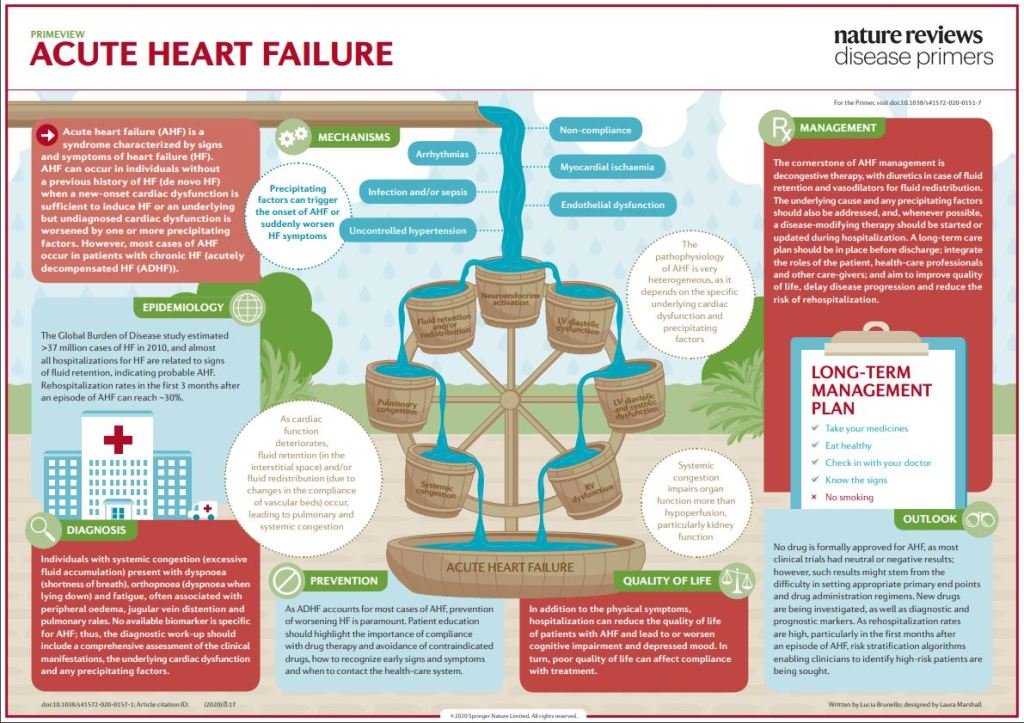
Infographic: Acute Heart Failure (Nature Reviews)

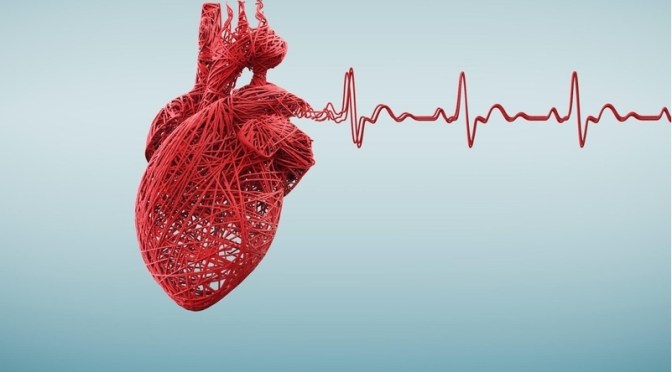
Acute heart failure (AHF) is a syndrome defined as the new onset (de novo heart failure (HF)) or worsening (acutely decompensated heart failure (ADHF)) of symptoms and signs of HF, mostly related to systemic congestion. In the presence of an underlying structural or functional cardiac dysfunction (whether chronic in ADHF or undiagnosed in de novo HF), one or more precipitating factors can induce AHF, although sometimes de novo HF can result directly from the onset of a new cardiac dysfunction, most frequently an acute coronary syndrome.

Despite leading to similar clinical presentations, the underlying cardiac disease and precipitating factors may vary greatly and, therefore, the pathophysiology of AHF is highly heterogeneous. Left ventricular diastolic or systolic dysfunction results in increased preload and afterload, which in turn lead to pulmonary congestion. Fluid retention and redistribution result in systemic congestion, eventually causing organ dysfunction due to hypoperfusion. Current treatment of AHF is mostly symptomatic, centred on decongestive drugs, at best tailored according to the initial haemodynamic status with little regard to the underlying pathophysiological particularities.

As a consequence, AHF is still associated with high mortality and hospital readmission rates. There is an unmet need for increased individualization of in-hospital management, including treatments targeting the causative factors, and continuation of treatment after hospital discharge to improve long-term outcomes.

COMMENTARY:

High frequency sound (ultrasound) bounces off of tissues, like an echo,  and allows an electronic look at the heart. Doppler echocardiography is the doctors method of choice for evaluating a heart failure. One of the most important numbers determined by this method is the EJECTION FRACTION, which is a measure of heart efficiency. If the ejection fraction is low, let’s say below 45%, the heart is pumping out only 45% of its volume with each stroke, which means it must work harder to produce the same amount of circulation. The normal is about 60%.

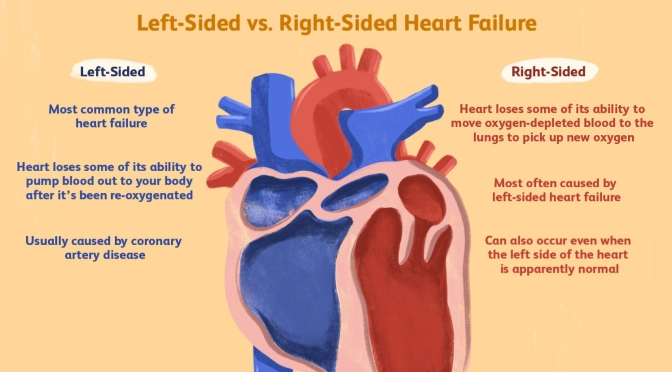
This is the basis of SYSTOLIC Heart failure.

The test can also tell about blood coming into the heart; the early part of the blood entering is usually 80% of the total. If it drops, let’s say below 50%, it means the heart is stiff and resists blood coming in, which is the basis of DIASTOLIC heart failure.

FACES Is an acronym-mnemonic for the symptoms of heart failure. F is for FATIGUE.

A is for ACTIVITY LIMITATION. C is for CONGESTION in the lungs.  E is for EDEMA, or swelling, usually of the ankles and legs. S is for SHORTNESS of BREATH.

If you want to remember a bit about heart failure, think about echoes and faces. If your Doctor orders an ultrasound with Doppler, be sure to ask about your ejection fraction and percent of blood that enters early, before the “atrial kick”. Being informed is always a good thing.

To be honest, I have never encountered a person who was given a Doppler echocardiogram and could tell me what his ejection fraction was, but I am eternally hopeful.

—Dr. C.

Heart Failure: ‘What It Is & How To Treat It’ (Video)

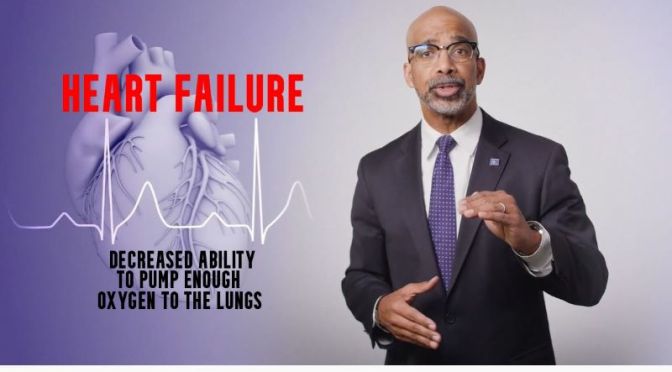
The heart is a hero. It works relentlessly to deliver oxygen and nutrients to the body. But just like all heroes, sometimes it gets tired, and can’t do its job as well. This is called heart failure – the inability for the heart to pump enough blood and oxygen to the lungs and rest of the body. In this video, Northwestern Medicine cardiologists Clyde W. Yancy, MD, MSc and Jane E. Wilcox, MD, MSc explain what heart failure is and the integrated and collaborative approach used to diagnose, stage and treat heart failure at Northwestern Medicine. For more information, visit http://heart.nm.org

YALE MEDICINE: ‘WHAT CAUSES HEART FAILURE?’

The heart is a muscle and it’s main job is to pump blood but certain things can cause that muscle to fail. There are genetic reasons, there are reasons related to valve disease, and there’s a viral infection that affects the heart called myocarditis.

The most common cause of heart failure is a heart attack. Fatty plaque builds up in the blood vessel that supplies the heart itself and unless that blood vessel is opened up immediately that muscle will die. The rest of the muscle that’s not dead anymore has to do extra to keep on pumping the blood and overtime it cannot keep and that’s when heart failure develops.

CARDIOLOGY PODCAST: “ATRIAL FIBRILLATION – A COMPREHENSIVE OVERVIEW”

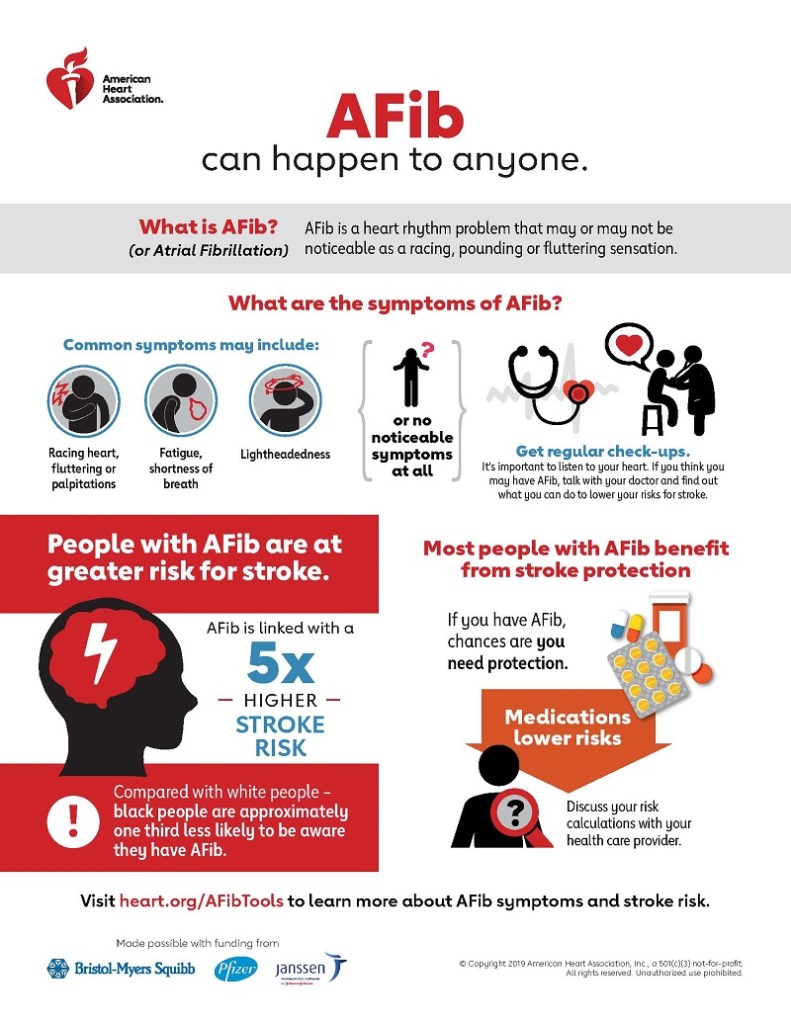
Atrial fibrillation is chaotic and irregular atrial arrhythmia, the prevalence of which increases progressively with age. It causes significant morbidity and death. Many patients are asymptomatic or have symptoms that are less specific for cardiac arrhythmias, such as mild dementia or silent strokes. 

Gregory Lip, Price-Evans Chair of Cardiovascular Medicine, University of Liverpool, gives us an overview of the condition.

Read more on Atrial Fibrillation at BMJ