
Tag Archives: Breast Cancer Screening

Breast Cancer: Benefits Of An Early Mammogram

A women’s lifetime risk of developing breast cancer is one in eight. Research has shown that the earlier you detect breast cancer the more options there are for treatment and a better chance for a cure.

What is a mammogram?

A mammogram is a low-dose X-ray of breast tissue. Healthcare providers use mammograms, or mammography, to look for early signs of breast cancer before symptoms develop. This is called a screening mammogram. Providers also use mammography to look for any abnormalities if you develop a new symptom, such as a lumppain, nipple discharge or breast skin changes. This is called a diagnostic mammogram.

Aside from skin cancer, breast cancer is the most common cancer that affects people assigned female at birth and represents 14% of all new cancer diagnoses in the United States. While breast cancer treatment therapies continue to improve and have contributed to a reduction in cancer-related deaths, early diagnosis through screening mammograms has a greater overall impact on survival rates.

Read more

Dr. C’s Journal: Types Of Cancer Screening Tests

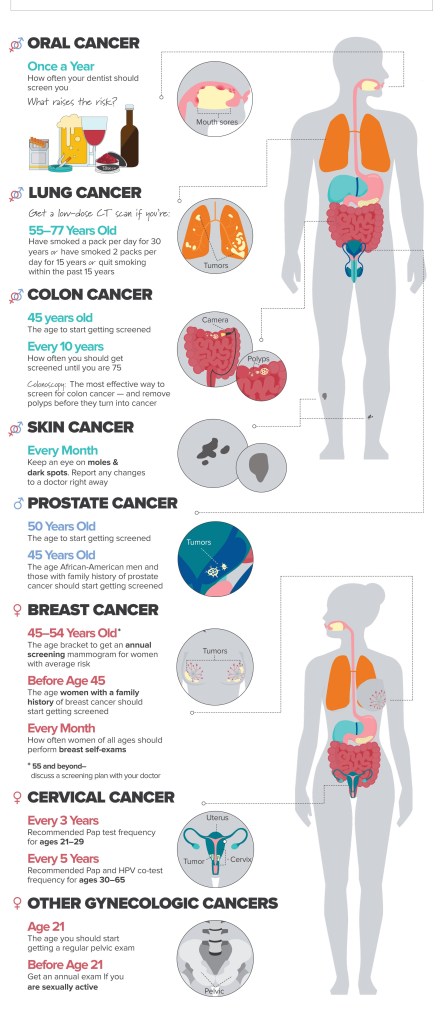
There are a number of recommended screening tests for cancer.

Mammography has been shown quite effective in reducing deaths from breast cancer, it is recommended for women ages 40 to 74.

HPV and PAP tests are recommended for cervical cancer screening in women. Testing should begin at age 21 and end at age 65.

Colonoscopy is recommended for colorectal cancer screening for both men and women ages 45 through 75.

HCT, a type of CT, is recommended for heavy smokers at ages 15 to 80.

Where the risks are high, there are other tests not generally recommended for everybody. Tests are available for liver cancer, prostate cancer, skin cancer, and ovarian cancer where are the risk is high. In women with BRCA1 And BRCA2  mutations, breast MRIs are recommended.

Personally, I get a yearly PSA test, mainly because a good friend, a physician, died within 3 years of prostate cancer when he stopped taking the test.

I also get a skin examination by a dermatologist every six months, because I have a very fair skin, probably caused by the freckle variant of the MC1R gene.

There are a number of symptoms and signs that suggest cancer,  particularly when they don’t go away, such as fatigue, weight loss or gain for no apparent reason; trouble swallowing, nausea, or abdominal pain; swelling or lumps anywhere in the body; cough or hoarseness; unusual bleeding; change in bowel habits; fevers or night sweats; bleeding areas in the mouth. Protracted headaches or vision problems can be worrisome.

In short, any distressing or unusual symptom that doesn’t improve on its own should be watched very carefully, and reported to your doctor; but it is far better to pick them up early with a test or a doctors routine examination than to wait for symptoms to develop.

—Dr. C.

Technology: The Lancet Digital Health – July 2022