Category Archives: Dr. C “Comments”

Health & Aging: The Importance Of Exercise (Scientific American)

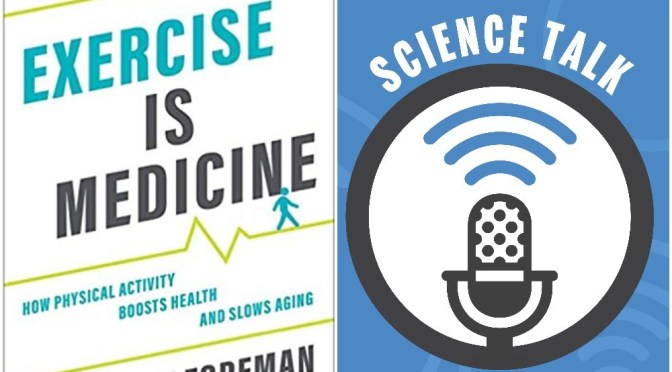
Health journalist Judy Foreman talks about her new book Exercise Is Medicine: How Physical Activity Boosts Health and Slows Aging

This is Scientific American’s Science Talk, posted on April 24th, 2020. I’m Steve Mirsky. And under our current, often locked-down situation, it’s still really important to try to get some exercise. Judy Foreman is the author of the new book Exercise is Medicine: How Physical Activity Boosts Health and Slows Aging. She’s a former nationally syndicated health columnist for the Boston Globe, LA times, Baltimore Sun and other places, and an author for the Oxford University Press. We spoke by phone.

Website

COMMENTARY

This Podcast is worth listening to in full. It will introduce some of the upcoming themes of DWWR.

Exercise is one of the 4 pillars of health, thriving and longevity, along with Diet, Sleep, and Intellectual Stimulation.  We look forward to highlighting and reveling in these subjects.

Judy Foreman’s thesis “ exercise is medicine” is true in many dimensions, including industries desire to capture the many beneficial biological effects of exercise in a pill; it requires effort to get off your duff, and you need to budget the time to work out.

My preference is WALKING and WATER EXERCISE. I make passing the time PLEASANT by listening to BBC “in our time”, recorded on a water-proof mp-3 player. EXERCISE is both VALUABLE and ENJOYABLE!

—Dr. C.
Coronavirus : The Race To Expand Antibody Testing, Public Health Investment

Benjamin Thompson, Noah Baker, and Amy Maxmen discuss the role of antibody tests in controlling the pandemic, and how public-health spending could curtail an economic crisis. Also on the show, the open hardware community’s efforts to produce medical equipment.

In this episode:

02:08 Betting on antibodies

Antibody tests could play a key role in understanding how the virus has spread through populations, and in ending lockdowns. We discuss concerns over their reliability, how they could be used, and the tantalising possibility of immunity.

News: The researchers taking a gamble with antibody tests for coronavirus

10:25 Economy vs public health, a false dichotomy

Jim Yong Kim, former president of the World Bank, argues that strong investment in public health is crucial to halt the ongoing pandemic and to prevent a global financial crisis. We discuss his work with US governors to massively increase contact tracing, and his thoughts on how researchers can help steer political thinking.

News Q&A: Why the World Bank ex-chief is on a mission to end coronavirus transmission

19:00 One good thing this week

Our hosts talk about staying positive, and pick a few things that have made them smile in the last 7 days, including a tiny addition to the team, a newspaper produced by children in lockdown, and a gardening update.

Six Feet of Separation, the newspaper staffed by kids

22:51 Open hardware

Researchers are stepping up efforts to design and produce ventilators and personal protective equipment for frontline medical staff. We hear how the open hardware movement is aiding these efforts, and the regulations that teams need to consider if their designs are to make it into use.

Technology Feature: Open science takes on the coronavirus pandemic

COMMENTARY

Coronavirus Testing and Tracking (1) are the two pillars of surveillance which will hopefully replace the “shotgun” method of universal distancing that America has tried so far. Quarantining only those who are contagious makes much more social and economic sense than quarantining everybody, and it seemed to work in South Korea (2) and Taiwan (3).

There are problems both with testing-accuracy and availability- and tracking, which is in tension with individuality and freedom.
Still we have no choice but to try, because people and businesses need to socialize and make some money.

Some epidemiologists predict that Covid 19 will smolder on, hopefully not overtaxing our health system, until “herd immunity” gets to 60-70 percent of the population.

As a highly susceptible octogenarian, I plan to keep my distance and become one of the minority protected by herd. And maybe an effective immunization or drug will come along.

—Dr. C.

TELECONSULTING: “DEEP BREATH IN” – THE BMJ LAUNCHES A NEW PODCAST

The BMJ’s new podcast aims to help doctors feel more connected, heard, and supported

“Deep breath in … and out. Again, deep breath in … and out.”

We tune in to patients’ breath sounds, seeking confirmation of a diagnosis—one more supporting piece of evidence to reassure anxious patients or to narrow the differential.

But since the SARS-CoV-2 pandemic arrived, saying “deep breath in” has been replaced by the need to take one ourselves: before looking at the morning news, before venturing out (or logging on) to work each morning, and before ringing the next patient on your list with the ominous note alongside their name: “fever and cough for a week, now feeling breathless.” Although chosen in what seems like a different era, the name for The BMJ’s new podcast for general practitioners—Deep Breath In—seems fitting for our troubled times.

Rebooting general practice

Before anyone in Wuhan fell ill, GPs had already been feeling the strain. In the UK, despite government promises of 5000 new practising GPs by 2020, there were 6.2% fewer full time equivalent GPs in 2019 than in 2015.1 Similarly, physicians in the US have been compensating for an estimated shortfall of some 14 500 primary care doctors since 2017.2 Recent attempts to take the strain off GPs in England by funding allied health professionals have faltered because of onerous new demands on fledgling primary care networks.3 Turning it off and switching it back on again is often the only thing that works when your computer grinds to a halt. Perhaps coronavirus will do the same for primary care.

Read more

COMMENTARY

Primary Care Physicians are a vanishing species [1]. This is unfortunate, since PCPs are the only doctors who attend the whole field of Medicine (have you ever asked an orthopedist about your cough?).

However, some of the slack is being taken up by Nurse Practitioners [2] and Physicians Assistants [3].

If you know a retired Internist or Family Practice Physician, be sure to cultivate a friendly relationship (and give them a hug when the Covid 19 epidemic cools off). They might be inclined to be that greatest of all Medical Resources- the Patient Advocate [4].

—Dr. C.