Parkinson’s Foundation (February 27, 2023) – Finding out you have Parkinson’s can be a lengthy process. Explore how a Parkinson’s diagnosis is made and what type of diagnostic tools are used.
Parkinson’s disease (PD)
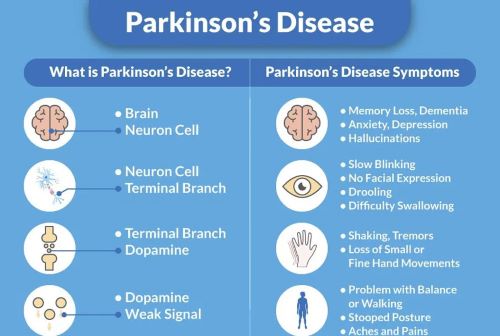
A neurodegenerative disorder that affects predominately the dopamine-producing (“dopaminergic”) neurons in a specific area of the brain called substantia nigra.
Symptoms
Symptoms generally develop slowly over years. The progression of symptoms is often a bit different from one person to another due to the diversity of the disease. People with PD may experience:
Tremor, mainly at rest and described as pill rolling tremor in hands; other forms of tremor are possible
Slowness and paucity of movement (called bradykinesia and hypokinesia)
Limb stiffness (rigidity)
Gait and balance problems (postural instability)
In addition to movement-related (“motor”) symptoms, Parkinson’s symptoms may be unrelated to movement (“non-motor”). People with PD are often more impacted by their non-motor symptoms than motor symptoms. Examples of non-motor symptoms include: depression, anxiety, apathy, hallucinations, constipation, orthostatic hypotension, sleep disorders, loss of sense of smell, and a variety of cognitive impairments.
Keeping bones healthy is important for everyone and especially important for people with Parkinson’s. We share some top tips for keeping your bones in tip top condition.
Key points
Bone health is important for everyone, but especially if you have Parkinson’s.
You are at more risk of getting osteoporosis when you have Parkinson’s, which can weaken bones and make them more likely to break.
Your healthcare team can assess you and may prescribe medication to help improve your bone health.
Strength exercises and maintaining a good diet can also help.
What is bone health?
Bone health really means having ‘healthy bones’. Healthy bones are strong enough to prevent fractures, for example when we have a fall. Our bones are more healthy when we have enough calcium in our diet (from milk, and dairy products like cheese) and when we use our arms and legs (such as with exercise).
REM sleep behavior disorder is linked to Parkinson’s disease, a movement disorder; dementia with Lewy bodies, which causes cognitive decline; and multiple system atrophy, in which the ability to regulate involuntary functions, such as blood pressure, breathing, and bladder and bowel function, deteriorates.
ROCHESTER, Minn. — People with rapid eye movement (REM) sleep behavior disorder act out their dreams. While sleeping safely in bed, for example, they might throw up their arms to catch an imaginary ball or try to run from an illusory assailant. Such actions are more than just a nuisance. People with the disorder have a 50% to 80% chance of developing a serious neurodegenerative disease within a decade of diagnosis.
Parkinson’s Disease is a MOVEMENT DISORDER. It is grouped with a number of OTHER NEURODEGENERATIVE illnesses which can show similar symptoms. When Parkinson-like problems are present in other syndromes, it is called PARKINSONISM, to distinguish it from primary Parkinson’s disease.
There is no 100% reliable sign, symptom or diagnostic test; Rather, the gold standard of diagnosis rests on the ability of experienced neurologists to discern a PATTERN of findings which together support the likelihood of Parkinson’s disease. The accuracy is about 80-90%. The 3 characteristic symptoms of PD are BRADYKINESIA, TREMOR, and RIGIDITY. Bradykinesia means SLOW MOVEMENT.
The typical Tremor is a tapping, “pill-rolling” motion that is present at rest, and DISAPPEARS ON MOTION. The Rigidity is pervasive, and patients describe it as trying to move in thick molasses. A “lead-pipe resistance”, stiffness and PAIN in the shoulder may be a first system, and not uncommonly the patient will often go to an Orthopedist or Rheumatologist. Depression, constipation, anosmia and SLEEP Disorders are common in the years leading up to the diagnosis of Parkinson’s Disease, and DEMENTIA frequently develops.
Genetics play a role, and PD can run in Families. Environmental causes such as Trauma and anoxia can injure nerve cells, as can Toxins. MPTP contamination of a drug supply once caused a surge of Parkinsonism. Degeneration of DOPAMINERGIC nerve cells in the Substantia Nigra is the ultimate cause of PD, and accumulation of ALPHA SYNUCLEIN fibrils is a correlate of that degeneration.
Practical treatment at present aims to boost Dopamine. Administration of Levodopa, a DA precursor, if effective, a response helps to confirm the diagnosis. Magnetic and electrical stimulation of the brain have been used. Experimental injections of Dopaminergic cells into the brain is under investigation. Causing Astrocytes to differentiate into dopaminergic cells has been successful in animals.
With Celebrities such as Michael Fox and Robin Williams raising awareness, and the Mechanism understood, I am optimistic that a real cure may be found in a few years.
–Dr. C.
Empowering Patients Through Education And Telemedicine




 Doctors Without Waiting Rooms