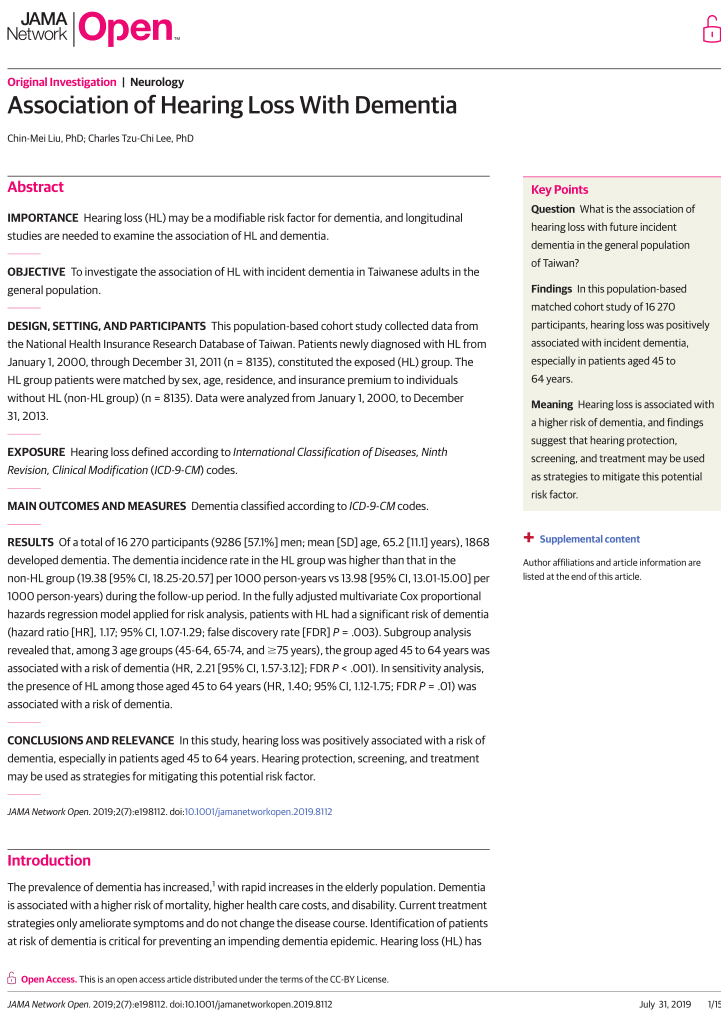
Age-related hearing loss may be linked to an increased risk of cognitive decline. And according to two large studies, … Dr. Ronald Petersen, a Mayo Clinic neurologist, says the exact reason why is not known. It also could be that hearing loss leads to social isolation, which can lead to an increased risk in dementia.
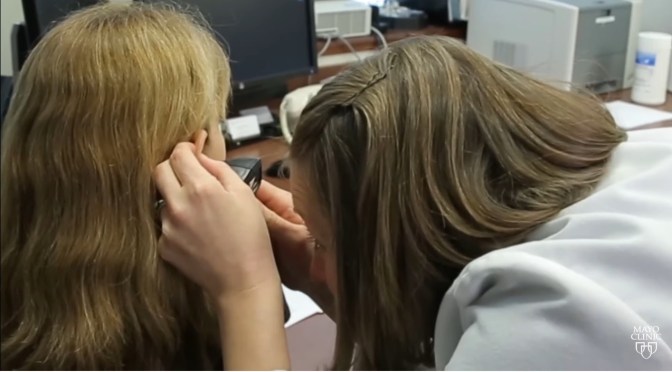
Dr. Petersen recommends getting your hearing assessed every two to three years, especially if you’re noticing signs that your hearing may be deteriorating. The fix could be as simple as needing to get earwax removed.
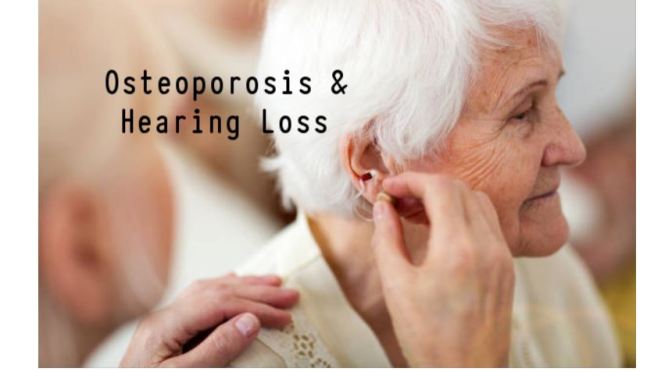
As part of the Conservation of Hearing Study (CHEARS), researchers from Brigham and Women’s Hospital analyzed data from nearly 144,000 women who were followed for up to 34 years. They found that risk of subsequent moderate or worse hearing loss was up to 40 percent higher in study participants with osteoporosis or LBD. The study, published in the Journal of the American Geriatric Society, also found that bisphosphonates did not alter risk of hearing loss.
The researchers found that a history of vertebral fracture was associated with up to a 40 percent higher risk of hearing loss, but the same did not hold true for hip fractures, the two most common osteoporosis-related fractures. “The differing findings between these skeletal sites may reflect differences in the composition and metabolism of the bones in the spine and in the hip,” Curhan said. “These findings could provide new insight into the changes in the bone that surrounds the middle and inner ear that may contribute to hearing loss.”
“We are learning that tactics to avoid dementia begin early and continue throughout life, so it’s never too early or too late to take action,” says commission member and AAIC presenter Lon Schneider, MD, co-director of the USC Alzheimer Disease Research Center‘s clinical core and professor of psychiatry and the behavioral sciences and neurology at the Keck School of Medicine of USC.
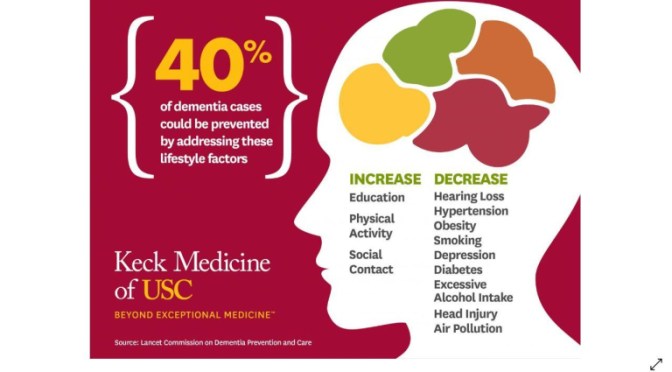
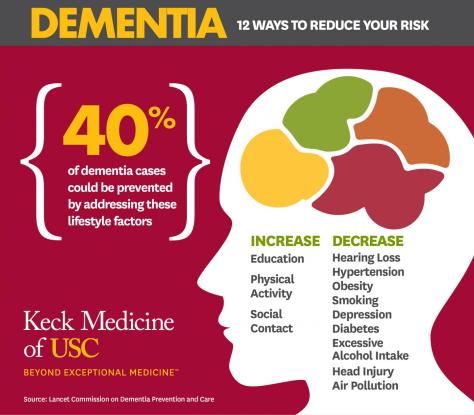
LOS ANGELES — Modifying 12 risk factors over a lifetime could delay or prevent 40% of dementia cases, according to an updated report by the Lancet Commission on dementia prevention, intervention and care presented at the Alzheimer’s Association International Conference (AAIC 2020).
Twenty-eight world-leading dementia experts added three new risk factors in the new report — excessive alcohol intake and head injury in mid-life and air pollution in later life. These are in addition to nine factors previously identified by the commission in 2017: less education early in life; mid-life hearing loss, hypertension and obesity; and smoking, depression, social isolation, physical inactivity and diabetes later in life (65 and up).
Schneider and commission members recommend that policymakers and individuals adopt the following interventions:
Aim to maintain systolic blood pressure of 130 mm Hg or less from the age of 40.
Encourage use of hearing aids for hearing loss and reduce hearing loss by protecting ears from high noise levels.
Reduce exposure to air pollution and second-hand tobacco smoke.
Prevent head injury (particularly by targeting high-risk occupations).
Limit alcohol intake to no more than 21 units per week (one unit of alcohol equals 10 ml or 8 g pure alcohol).
Stop smoking and support others to stop smoking.
Provide all children with primary and secondary education.
Lead an active life into mid-life and possibly later life.
Reduce obesity and the linked condition of diabetes.
Even limited hearing loss might be associated with cognitive decline. If true, early intervention with hearing aids might help people have better cognitive performance.
Michael Johns III, MD, online editor for JAMA Otolaryngology, speaks with Justin Golub, MD, MS, assistant professor of otolaryngology at Columbia University, whose research has shown that very mild hearing loss can be associated with cognitive disability.
COMMENTARY
Hearing loss and cognitive ability decline together as we age, starting earlier in some people than others.
LIVING A HEALTHY LIFE STYLE-with good SLEEP, DIET, EXERCISE and COGNITIVE STIMULATION -seems to help benefit almost everything, including hearing, while a poor life style, neglecting the 4 Pillars, smoking, and drinking alcohol to excess seems to hasten our aging.
Certain medications, often taken to treat the results of a poor life style, can also harm our hearing.
LOUD SOUNDS (such as AMPLIFIED MUSIC), especially if prolonged, are particularly bad. SOUND POLLUTION contaminates the modern world as much as industries‘ excesses. I would often wear ear plugs to Football games (108 dB on my meter) and even in row 4 of the Symphony.
Once damaged, the delicate HAIR CELLS of our inner ear don’t grow back, although medical science once again is working feverishly to save us from ourselves.
Hearing aids can now be programmed to compensate for our particular pattern of frequency loss.
The premise made in the above article and podcast, that decreased HEARING is accompanied by (and Causes?)decreased COGNITION could be supported by a study demonstrating that Improved hearing restores the cognition. I understand that early results may suggest a cognitive benefit of hearing aids.
But PRESERVING BOTH with healthy living would of course be better- at least in my opinion.
Prevention, unfortunately, is a very hard sell in a world of costly medical treatments, where we are protected from directly confronting those costs by ever-expanding insurance. How about Medical savings accounts?

 Doctors Without Waiting Rooms