If screening tools and self-checkers do not lead you to the care or information you are seeking, you can reach out directly to your doctor or health insurance company for options that can help connect you to a provider online. Understanding telehealth
Whether you’re looking for health care related to COVID-19 or something else, find out more about how to prepare for the visit. Preparing for a video visit
Until recently, there were several barriers preventing widespread adoption of telemedicine. The two broad themes were:
Providers, health systems, and payers were slow to embrace change
A failure to appreciate that telemedicine is not a new type of medicine, but rather simply a care delivery mechanism that can be utilized with some patients, some of the time, to provide high-quality care
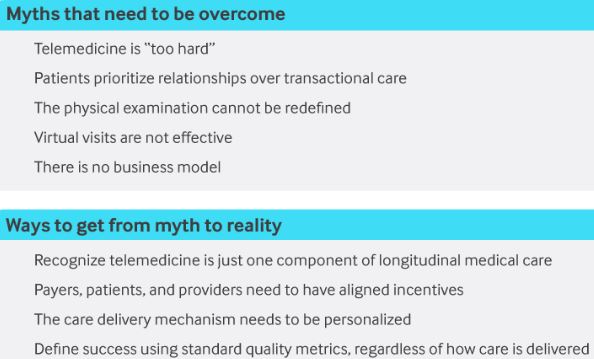
Addressing the Telemedicine Myths
Myth 1: Telemedicine is “too hard.”
This was not true before Covid-19 and we have further demonstrated that it is not true now. Almost every provider and the great majority of patients in the U.S. already possess the technology needed to conduct a telemedicine visit — a smartphone, tablet, or computer.
It turns out that when fear of catching a potentially fatal disease strikes, telemedicine is no longer too hard.
Myth 2: Patients prioritize existing relationships with their provider over transactional episodic care.
Data argues otherwise: The majority of times, patients just want care. Falling primary care visits rates, coupled with growing emergency department and urgent care visit rates, suggests convenience as more important than an established relationship.
Myth 3. You cannot do a physical examination.
It turns out you can. A new 21st-century physical exam utilizing telemedicine emphasizes the importance of general appearance (sick or not sick, weight, distress), respiratory effort, and environmental factors including a visual assessment of the home that is not something that can be accomplished at an office visit.
The majority of times, patients just want care.
Myth 4: Virtual visits are less effective than in-person visits.
Focusing on the comparison in diagnostic accuracy between virtual and in-person visits sets up a false dichotomy. Focusing on actionable information is more important than diagnostic accuracy.2 Actionable information recognizes providers might not always make a diagnosis within a single visit, whether in-person or telemedicine.
Like every other new challenge, you have to try telemedicine to get comfortable with it.
Myth 5. There is not a payment model supporting telemedicine.
While it is true that the Centers for Medicare & Medicaid Services (pre-Covid-19) had limited reimbursement based upon site of service and geography, since the Covid-19 outbreak, to the credit of the federal government and commercial payers, telemedicine is now covered.
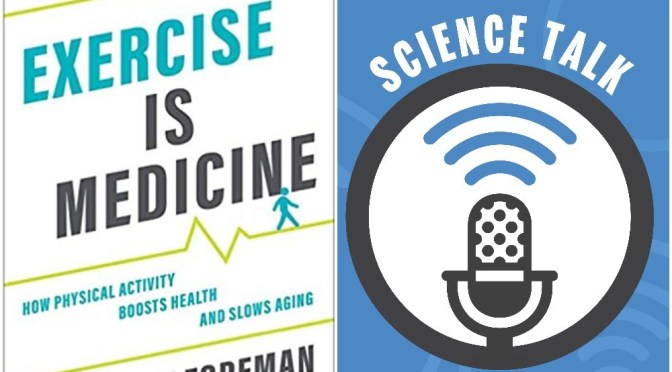
Health journalist Judy Foreman talks about her new book Exercise Is Medicine: How Physical Activity Boosts Health and Slows Aging
This is Scientific American’s Science Talk, posted on April 24th, 2020. I’m Steve Mirsky. And under our current, often locked-down situation, it’s still really important to try to get some exercise. Judy Foreman is the author of the new book Exercise is Medicine: How Physical Activity Boosts Health and Slows Aging. She’s a former nationally syndicated health columnist for the Boston Globe, LA times, Baltimore Sun and other places, and an author for the Oxford University Press. We spoke by phone.
This Podcast is worth listening to in full. It will introduce some of the upcoming themes of DWWR.
Exercise is one of the 4 pillars of health, thriving and longevity, along with Diet, Sleep, and Intellectual Stimulation. We look forward to highlighting and reveling in these subjects.
Judy Foreman’s thesis “ exercise is medicine” is true in many dimensions, including industries desire to capture the many beneficial biological effects of exercise in a pill; it requires effort to get off your duff, and you need to budget the time to work out.
My preference is WALKING and WATER EXERCISE. I make passing the time PLEASANT by listening to BBC “in our time”, recorded on a water-proof mp-3 player. EXERCISE is both VALUABLE and ENJOYABLE!
From an article in MedPage Today by Michael C. Luciano, MD:
You often hear about the practice of medicine which, by definition, is the repetition of a skill set to gain proficiency. All the education, hard work, and countless patient visits are part of this practice.
The art of medicine is the application of all this information and skills we learn and relaying this in a humane way to this one patient in front of you, which is the only thing that matters at this moment. I am here for you is what each patient deserves to feel. This, in my opinion, is what separates the good doctor from the great doctor. That skill is innate. Those going into the field for the right reasons have this within them.
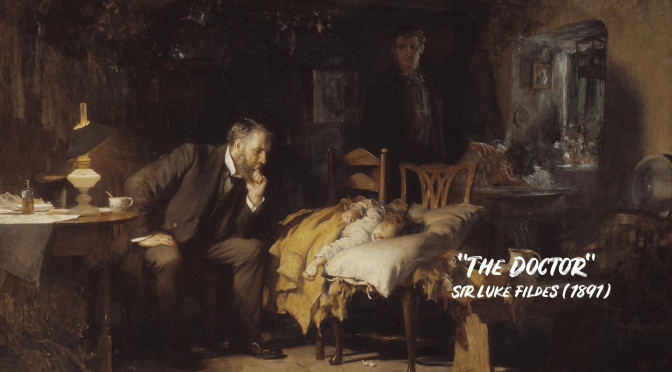
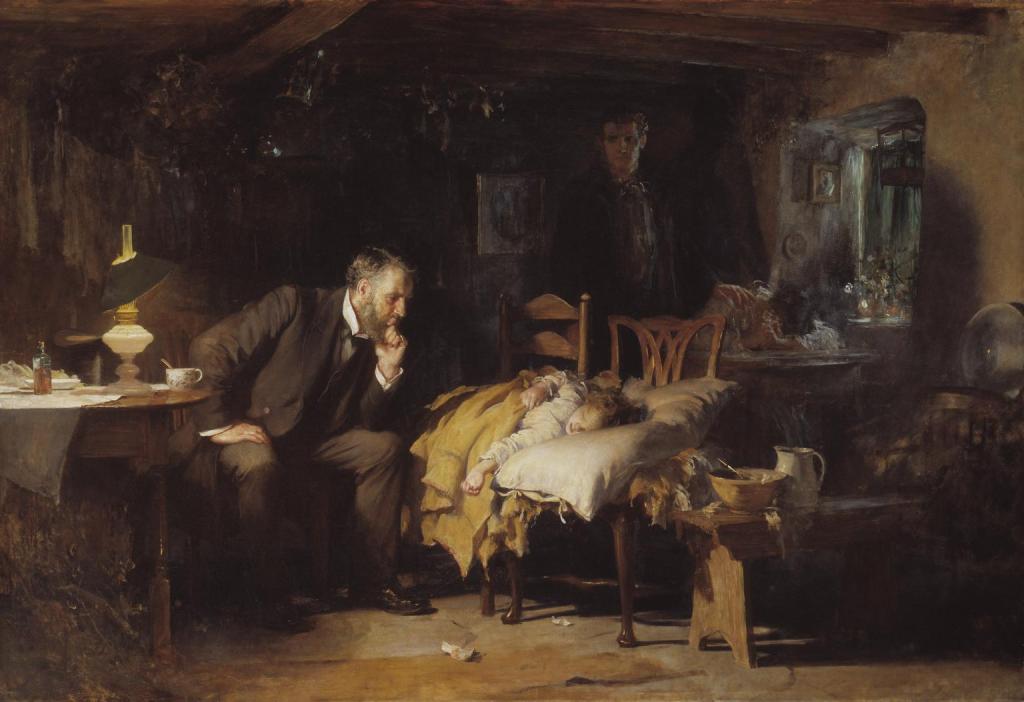
In 1890 Sir Henry Tate (1819-98) commissioned a painting from Luke Fildes, the subject of which was left to his own discretion. The artist chose to recall a personal tragedy of his own, when in 1877 his first son, Philip, had died at the age of one in his Kensington home. Fildes’ son and biographer wrote: ‘The character and bearing of their doctor throughout the time of their anxiety, made a deep impression on my parents. Dr. Murray became a symbol of professional devotion which would day inspire the painting of The Doctor’ (Fildes, p.46). Fildes invented a new setting and characters for his painting, and in 1890 he made several sketches.
One year after Tate’s commission, The Doctor was exhibited at the Royal Academy. Agnews immediately published an engraving of it which sold over one million copies in the United States alone and became one of the most profitable prints made by the firm. The popularity of the painting confirms the popularity of social realism in art at this time, and Fildes was one of a number of artists, including Frank Holl (1845-88) and Hubert von Herkomer (1849-1914), whose paintings of the hardships of working class life were widely reproduced in The Graphic magazine. The Doctor was one of the fifty-seven pictures offered by Henry Tate as a gift to the nation in 1897.



 Doctors Without Waiting Rooms