
Tag Archives: Walking

FALLS AMONG THE ELDERLY: CONDITIONS & PREVENTION

Falling down is common on both ends of the Human lifespan. Little kids are always falling down, but there isn’t much energy to dissipate, since their mass is small and they don’t have far to fall. Moreover, their bones are pliable.

The Elderly also fall, increasingly, as they age. They have a lot further to fall, and their bones are often brittle and osteoporotic. Injury is quite common, they often break a hip, and may slide into a peogressive deterioration leading to their demise..

Ordinary walking, a “normal gait”, is a very complex activity and requires a lot of information and coordination by the nervous system.

VISION is critical, as you are often navigating through a minefield of stairs, rug edges, slippery objects, lamp cords, tubes and pets. Cataracts may be a problem to be corrected. Multifocal glasses can be a factor.

HEARING can warn of certain hazards or warnings and is important. A FINE SENSE OF TOUCH is required to give you cues as you are walking. Peripheral neuropathy can make walking difficult.

PROPRIOCEPTION, the positional sense of where your extremities are located in space, is a sense we take for granted, but which may deteriorate in time. Proprioception is very important for a normal Gait. The inner ear, with it’s semicircular canals and vestibular apparatus is necessary for proper BALANCE.

Balance can be PRACTICED in a number of ways, like standing on one leg, or merely WALKING a lot. These MULTIPLE SENSES must be COORDINATED by the Thalamus, Corpus Striatum, medulla, Cerebellum, and Cerebral Cortex and instructions sent to the muscles of your Legs, Arms, back and abdomen.

It is mandatory to keep these muscles, your Heart and your body, STRONG and FIT. Factors that make you more likely to have a fall are mostly the reverse of the above, and are called RISK FACTORS.

  • –Previous Falls are the best predictor. More than 2 or 3 in a year is worrisome.
  • –Balance Impairment is best treated by practice.
  • –Decreased Muscle strength. –Visual impairment.
  • –Polypharmacy (more than 4 prescription Meds), or a Psychoactive drug (look up)
  • –Gait impairment, Walking difficulty.
  • –Depression, which is often treated by antidepressants or sleeping pills- Psychoactive drugs.
  • –Dizziness or orthostatic hypotension, which causes a drop in blood pressure on standing. and a number of other problems, often a function of age.

PREVENTION of falls is of course better than treatment of the resulting INJURY. Working on your HEALTH will help the INTRINSIC causes of falls, and that is what we have been discussing.

Preventing the EXTRINSIC causes of falls means working on: –Improving the household safety by putting in railings, getting rid of throw rugs, clutter, and maybe pets( a good friend went into a downward spiral after tripping over his Dog.

Adjusting or eliminating psychoactive drugs and antihypertensive drugs (which often include the beta blockers which worsen orthostatic hypotension.

Interestingly, VITAMIN D supplements were mentioned in 2 references I saw. Apparently Vitamin D reduces falls by increasing MUSCLE STRENGTH.

Please refer to the following Canadian article for a more complete discussion.
–Dr. C.

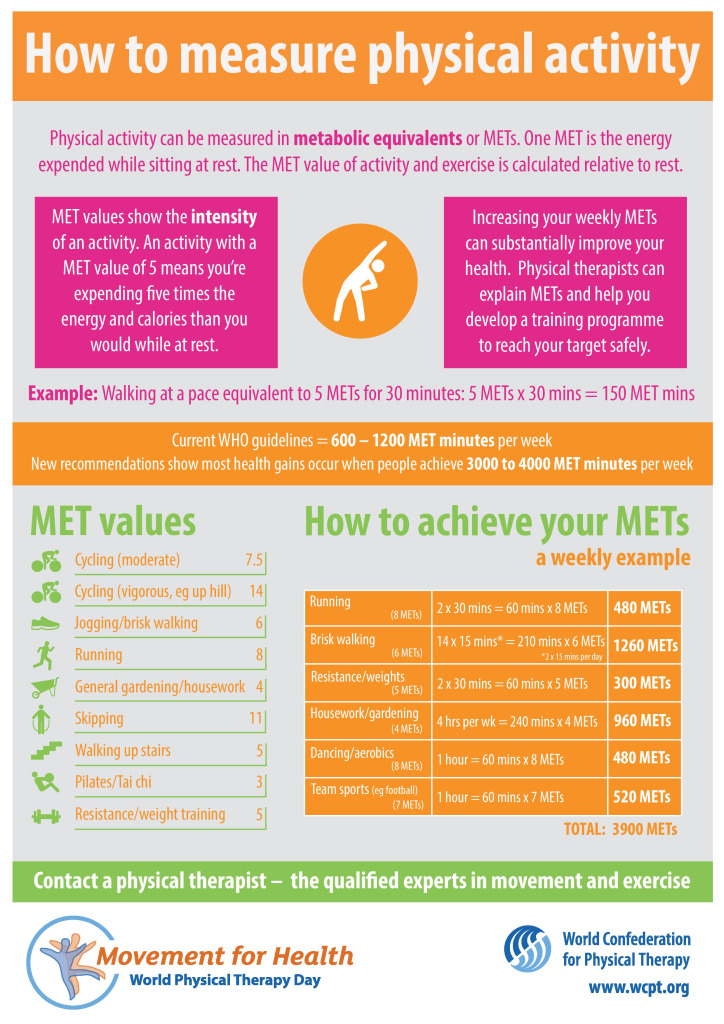
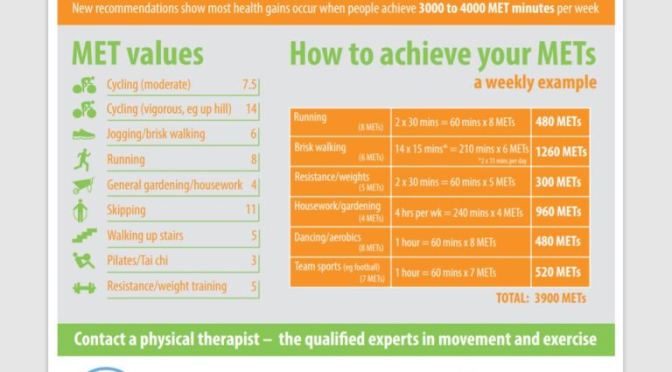
INFOGRAPHICS: “HOW TO ACHIEVE YOUR WEEKLY RECOMMENDED EXERCISE”

COMMENTARY

The idea of “METS” as a unit of energy expenditure is interesting and practical. I agree that EXERCISE IS IMPORTANT.

Frank Wilczek, in an article on Dyson Freeman, talked about another unit that I find even more interesting . He proposed that 100 Watts be the unit of energy expenditure. This is (approximately) the energy used in an old 100 Watt incandescent light bulb. It is also the amount of energy used by the “average” human on a 2000 Calorie diet.

Using this unit, the average U.S. Citizen uses 95 units, compared to a 25 unit world average. The suns output is 5 X ten to the fourteenth power, of which 1X ten to the fourth power units lands on earth. Good cocktail information.

I also read that a professional cyclist has an output of only 400 watts, vs. the 14 Mets mentioned in the article.but when I read that the human body is only 20-25% efficient in converting Calories to Watts  of Output, 14 Mets made more sense.

—Dr. C.

THE DOCTORS 101 CHRONIC SYMPTOMS & CONDITIONS #5: SCIATICA & BACK PAIN

Chronic back pain and sciatica are very common, and increasing in prevalence. The human back does not seem to have been designed for obesity coupled with sedentary habits. I have had both back pain and sciatica . My wife had surgery in an attempt to control her back pain, my son successfully controlled his back pain with medical treatment, and an 87 year old friend recently had successful micro-neurosurgical treatment.

I will summarize these stories and will finish with some generalizations I believe will help those wanting to avoid a lot of misery. The sooner you start the better.

My back pain developed after an ill-advised use of a shovel to get rid of some grass intruding on my asphalt driveway, and caused me to miss work for the only day in 35 years of practice. Sciatica then developed on my left side. I could not sleep flat, and would sit all night in a comfortable chair. A hospital bed helped me outlast the impressive calf pain.

My wife developed severe back pain eventually leading to a “laminectomy and fusion”. Some level of back pain and incapacity plagued her the rest of her life.

My son developed severe sciatica and went to an Orthopedist. After a CAT scan revealed a rupture disc, he was penciled in for surgery. When asking about alternative treatments, the doctor told him, half laughingly, to lose 20% of his body weight and to start swimming. He went on a 30 day, 1000 calorie/day diet and lost 30 lbs. He has been swimming daily for the past 10 years. He has had no more back pain.

My 87 year old friend developed sciatica on his right side, had no luck with PT and pain meds including opioids. Microsurgery by a neurosurgeon successfully removed his ruptured disc, and he has had little or no pain after the first week.

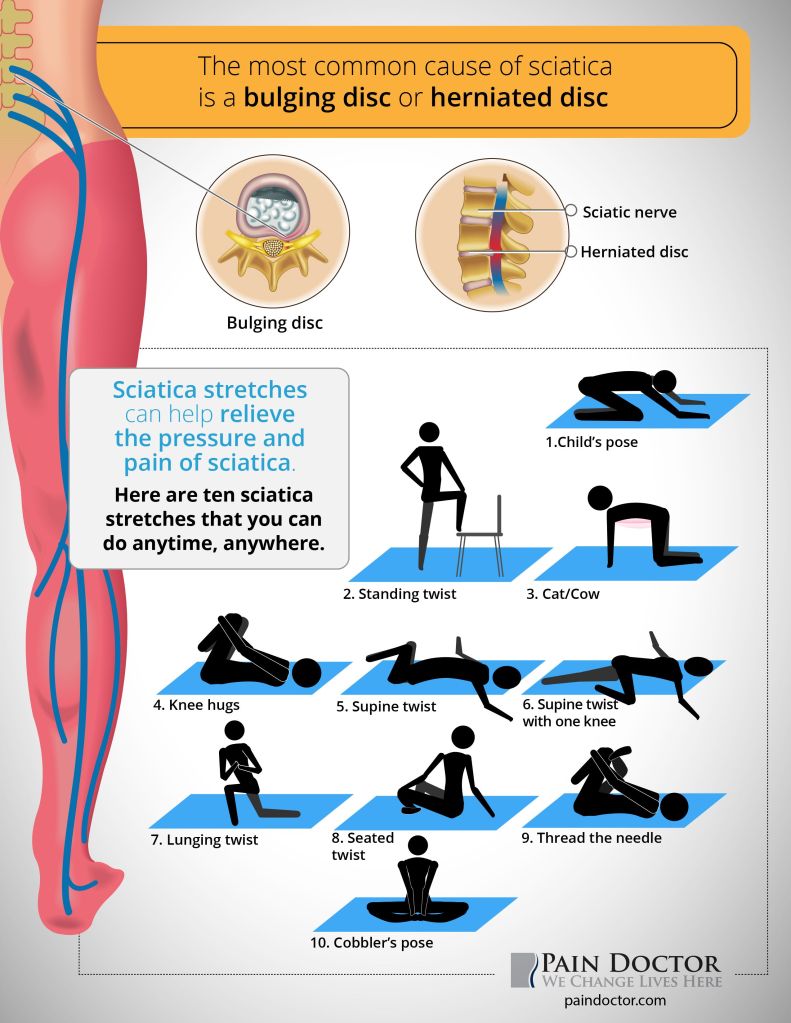
Sciatica at least has a well defined cause: something is irritating that long nerve which starts in the small of the back and travels to its’ destination in the foot. That something is often an extrusion from an intervertebral disc, a cushion between the block-like vertebral bodies.

This herniation can be confirmed by a CAT scan or MRI, and removed by minimally invasive microsurgery. Beyond that model problem, down through spinal stenosis and ending in chronic back pain, the understanding gets progressively more fuzzy, treatment ever more contrived.

Prevention sounds better and better. The most important thing in preventing back pain is to MAINTAIN A NORMAL WEIGHT. Our backs were not designed for vertically compressive forces. The lock-step increasing incidences of obesity and back/sciatic problems support this idea.

REGULAR EXERCISE is very important. Swimming and walking are 2 of the best forms of exercise. Exercises like running on hard surfaces, jumping in volleyball, and weight lifting seem less optimal.

The ABDOMINAL MUSCLES stabilize the spine, and prevent excessive motion. Walking and swimming both exercise and strengthen the abdominals.

Maintaining FLEXIBILITY and RANGE OF MOTION are important. flexibility will help prevent those unplanned, sudden motions from throwing your back out of alignment, or maybe generating a painful muscle tear.

Finally, getting into the habit of BENDING YOUR LEGS and tensing the stabilizing abdominals when you pick up something on the floor is a help.

I question the wisdom of back surgery for back pain alone, especially if accompanied by spinal fusion. Even when there is sciatica, the statistics show that treatment with surgery is no better than medical therapy after 2 years.

The development of microsurgical techniques may give surgery an edge, however. At the risk of cliche, AN OUNCE OF PREVENTION IS WORTH A POUND OF CURE.

–Dr. C