Tag Archives: Spinal Stenosis

Spinal Stenosis: Causes &Treatment (Mayo Clinic)

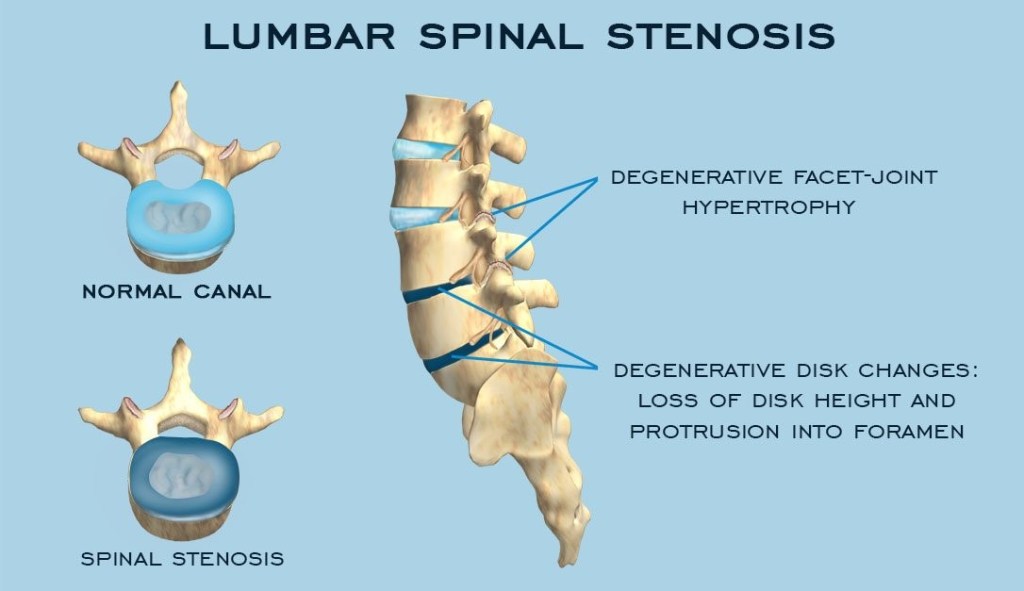
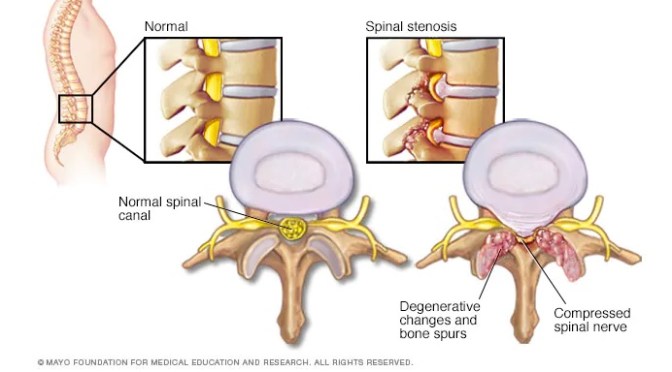
Mayo Clinic (March 30, 2023) – Spinal stenosis happens when the space inside the backbone is too small. This can put pressure on the spinal cord and the nerves that travel through the spine. Spinal stenosis occurs most often in the neck, called cervical spinal stenosis, and in the lower back, called lumbar spinal stenosis.

Spinal stenosis - Symptoms and causes - Mayo Clinic

The most common cause of spinal stenosis is wear-and-tear changes in the spine related to arthritis. Most people with spinal stenosis are over 50. Younger people may be at higher risk of spinal stenosis if they have scoliosis or other spinal problems.

Symptoms

Spinal stenosis often causes no symptoms. When symptoms do occur, they start slowly and get worse over time. Symptoms depend on which part of the spine is affected.

Spinal stenosis in the neck can cause:

  • Numbness
  • Tingling or weakness in a hand, leg, foot or arm
  • Problems with walking and balance
  • Neck pain
  • Problems with the bowel or bladder

Spinal stenosis in the lower back can cause:

  • Pain or cramping in one or both legs that happens when you stand for a long time or when you walk
  • Back pain

Treatment

Treatment for spinal stenosis depends which part of the spine is affected and the severity of your symptoms.

Nonsurgical treatment can include:

  • Medication.
    For control of pain, your health care professional might prescribe nonsteroidal anti-inflammatory drugs, antidepressants, anti-seizure drugs or opioids.
  • Physical therapy.
    A physical therapist can teach you exercises that can build up your strength and endurance, maintain the flexibility and stability of your spine, and improve your balance.
  • Steroid shots.
    Your nerve roots can become irritated and swollen at the spots where they are being pinched. Injecting a steroid medication into the space around the pinched nerve can reduce the inflammation and relieve some of the pain. Repeated steroid injections can weaken nearby bones, tendons and ligaments, though. That’s why a person often must wait many months before getting another steroid injection.
  • Removal of thickened ligament tissue.
    Sometimes, the ligament at the back of the lumbar spine gets too thick. Needlelike tools inserted through the skin can remove some of the ligament. This can create more space in the spinal canal to reduce pressure on nerve roots.

Surgeries to create more space within the spinal canal may include:

  • Laminectomy.
    This surgery removes the back part, or lamina, of the affected spinal bone. This eases pressure on the nerves by making more space around them. In some cases, that bone may need to be linked to nearby spinal bones with metal hardware and a bone graft.
  • Laminotomy.
    This surgery removes only part of the lamina. The surgeon makes a hole just big enough to relieve pressure in a specific spot.
  • Laminoplasty.
    This surgery is done only on spinal bones in the neck. It makes the space within the spinal canal bigger by creating a hinge on the lamina. Metal hardware bridges the gap in the opened section of the spine.
Back Pain: The Symptoms And Causes Of Sciatica

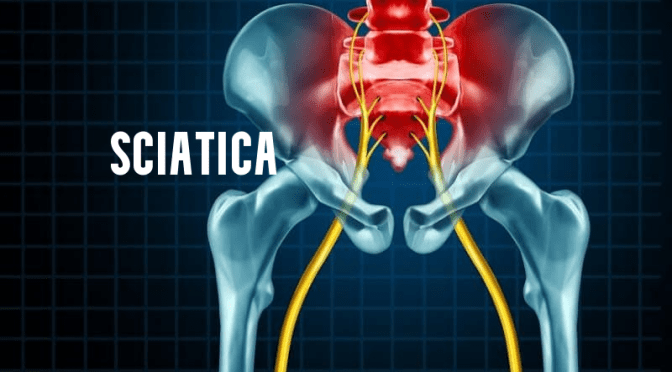
Most sciatica is caused by problems that affect the L4L5, or S1 nerve roots. The nerve may be compressed or irritated, usually because it’s being rubbed by a disc, bone, joint, or ligament. The resulting inflammation makes the tis­sues and the nerves more sensitive and the pain feel worse.

Damage to or pinching of the sciatic nerve, or the nerves that feed into it, can have several causes.

Herniated disc

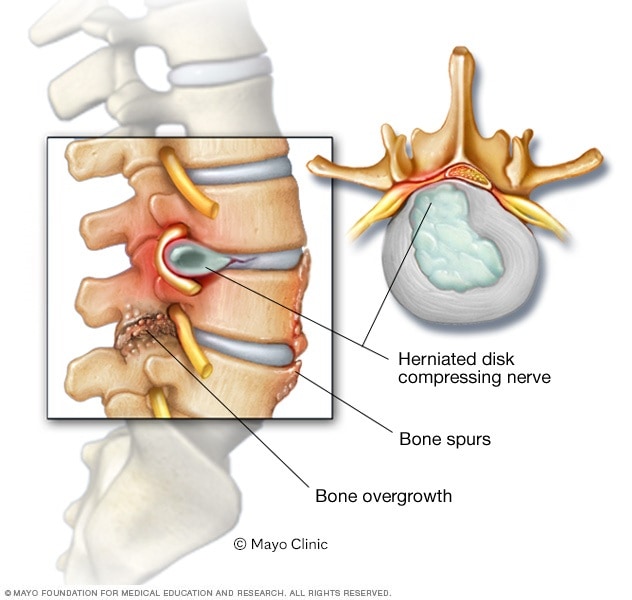
One of the most common causes of sciatica is a herniated disc in the lower part of the spine. It’s also called a slipped disc, though there’s no slipping going on.

Spinal discs are tucked between the vertebrae, where they act as cushions to keep the bones from touching one another. The discs absorb all the forces placed on the spine from walking, running, sitting, twisting, lifting, and every other activ­ity we do. They also absorb forces from falls, collisions, and other accidents.

Spinal stenosis

The spinal canal protects the spinal cord and the nerves that run up and down the spine. Spinal stenosis is the narrowing of the spinal canal. When this occurs, nerves can be compressed, causing pain. Because the lumbar verte­brae undergo the most consistent stress and support the most weight, lumbar stenosis is the most common type of spinal stenosis.

Spondylolisthesis

The bones of the spine are stacked on top of one another, separated by discs. Spondylolisthesis occurs when one spinal bone slips forward in relation to the bone below it. When the L4 vertebra moves over the L5 vertebra, it can cause a kink in the spinal canal leading to pressure on a nerve root and sciatica.

Read more

THE DOCTORS 101 CHRONIC SYMPTOMS & CONDITIONS #58: SPINAL STENOSIS

Spinal stenosis is a narrowing in the spinal canal. Constriction of the spinal nerves can produce pain that goes down one or both of the arms or legs, depending on the location of the stenosis. Malfunction of the nerves can cause numbness In the arms or legs, or weakness in muscles served by the affected spinal nerves.

Your doctor can confirm the diagnosis with imaging techniques such as MRI or CT scan.

The interesting part of this condition to me is the tremendous advances in surgical techniques that have taken place in the past decade. Many surgeries are now done through an endoscope, which limits the surgical disruption in the area. There is even a needle guided procedure to remove part of the ligament that is causing compression of the nerve.

Depending on the exact problem, small amounts of bone or other tissues can be removed, especially if the exact site of compression has been identified. If the extent of compression is more extensive, increasing amounts of bone is removed from the lamina (bony arches), facets , or nerve outlets (foramina) to give the nerves more room.

If there is slippage of the vertebra, a fusion is sometimes done. My understanding is that fusion is becoming less common. That being said, the Cloward procedure in the neck, with its approach from the front, is still sometimes used with neck pain.

Pain in the neck or back without any associated nerve malfunction is often best treated with physical therapy, steroid injections, or other conservative methods.

In my opinion spinal surgery is best done by trained neurosurgeons, who are familiar with minimally invasive surgery.

—Dr. C.

Read article #1

Read article #2