Tag Archives: Neurons

Science: New Research Into Diseases Of The Brain

Take an animated look inside the neuron, and learn how scientists are addressing brain disease. With approximately 86 billion neurons in the brain, humans contain the most complex communications network imaginable. To address diseases of brain development and degeneration, neuroscientists are investigating how and why this network breaks down, and what can be done to repair it.

One area of study is dendrites, which are the tree-like structures of neurons, that receive electrical impulses. Researchers are carefully mapping out brain circuits and uncovering how connectivity changes can result in defects of the visual system or behavioral problems. The core section of the neuron is the cell body. Genetic engineering tools are revealing how mutations impact brain development and contribute to autism spectrum disorder or rare, inherited forms of neurological disease.

The transmission of nerve impulses occurs along the axon, which is insulated, much like an electrical wire, by a fatty layer called the myelin sheath. Scientists have invented a medicine to stop the immune system from mistakenly attacking this layer, which occurs during multiple sclerosis. Other molecules currently in development instruct the body to regenerate the sheath and repair damage. The axon also transports valuable cellular cargo, such as neurotransmitters, along tracks from one end of the neuron to the other.

Researchers are testing drug candidates for their ability to remove molecular traffic jams when this transport system fails, as often occurs in Parkinson’s and Alzheimer’s disease. The axon terminals make connections called synapses with other cells, using neurotransmitters as signals. Some scientists are evaluating how finely tuning the receptors for these chemicals could ease depression and anxiety.

Others are finding ways to promote the regrowth of lost synapses, which could halt neurodegeneration. From genetics to behavior, neuroscience is accelerating new interventions for the most challenging disorders of the nervous system.

Learn more: https://www.scripps.edu/
Old Age: ‘Hyperexcitable Neurons’ Interrupt Sleep

For many older adults, a good night’s rest is elusive. The implications of chronically poor sleep can be far-reaching and include a decline in cognitive functioning and detrimental effects on health and general well-being. Fortunately, relief may be in sight.

A new study led by investigators at the Stanford University School of Medicine shows that neurons in the lateral hypothalamus, a brain region, play a pivotal role in sleep loss in old mice. More specifically, the arousal-promoting hypocretin neurons become hyperexcitable, driving sleep interruptions.

Read the full story: https://stan.md/3JQ7z77

Luis de Lecea, PhD, is a professor of psychiatry and behavioral sciences at Stanford Medicine. He is the study’s senior author and hopes the finding could pave the way to new drug treatments for age-related sleep problems in humans.

Shi-Bin Li, PhD, is an instructor in the Psychiatry and Behavioral Sciences department at Stanford Medicine. He is also a basic life research scientist in the de Lecea lab, and is the lead author of the study. Lisa Kim is Senior Manager of Media Relations for Stanford Medicine and Stanford Health Care. Lisa has a deep background in journalism, as she is an Emmy Award-winning journalist who has covered stories on both the national and local levels.

TREATING DEPRESSION: DEEP BRAIN STIMULATION (UCSF)

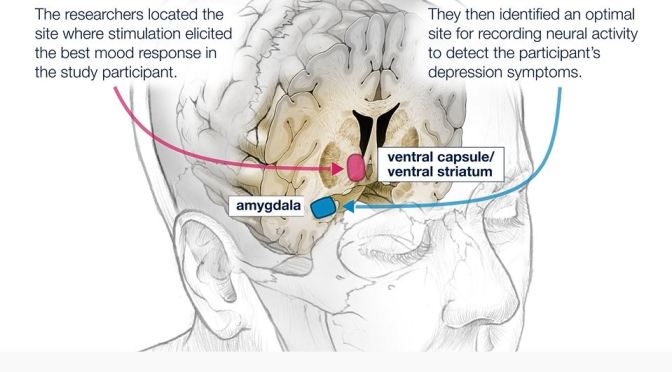
UCSF Health physicians have successfully treated a patient with severe depression by tapping into the specific brain circuit involved in depressive brain patterns and resetting them using the equivalent of a pacemaker for the brain.

COMMENTARY:

UCSF is my medical alma mater, and I am proud to comment on their info graphic about need-driven deep brain stimulation (DBS). This is not only a good idea, it should spearhead a personalized wave of the future.

Your body’s metabolism is a great balancing act, and needs to be kept on an even keel, to maintain the stability of your internal environment. What is “good” at one time may be deleterious at another.

Good illustrations of this are insulin and thyroid hormone. Both too little and too much is deleterious.

Likewise, the need for DBS varies.. This was recognized by the designers of feedback-driven DBS. The amygdala is overactive when the depressive wave is greatest, triggering the deep brain stimulation. As the depressive wave lightens, the stimulation diminishes or stops.

Engineers are quite attentive to this idea.  A similar feedback mechanism is used by implanted heart stimulators, or “ defibrillators“. if the heart slows down excessively, there is stimulation of the atrium to restore the proper rate. If the ventricle is ineffective, and fibrillates, it is given a shock which acts like rebooting your computer.

Chronotherapy, the administration of medication depending upon the time of day, is a kindred idea, illustrated by asthma. Wheezing attacks peak at night, when adrenaline and cortisol ebb, and so should the blood levels of the anti-asthmatic medication, theophylline.

Another illustration is the medication omeprazole, a proton pump inhibitor that reduces stomach acid. Reflux of this acid into the esophagus increases when you are recumbent and sleeping.. The need for the antacid is therefore greatest at night.

It is estimated that the effects of at least 50% of all medications would  benefit by attending to the diurnal cycles. If your symptoms cycle with the sun, ask your doctor about your medications.

—Dr. C.