
Tag Archives: Hemorrhagic stroke

The Two Types Of Stroke: Ischemic & Hemorrhagic

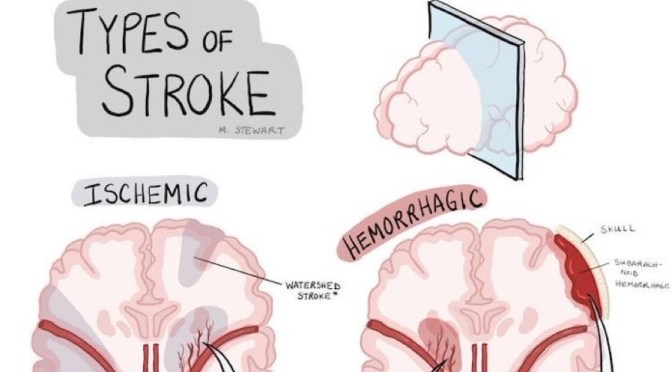
There are two types of stroke:

transient ischemic attack (TIA) is sometimes called a “mini-stroke.” It is different from the major types of stroke, because blood flow to the brain is blocked for only a short time—usually no more than 5 minutes.1

Ischemic stroke

Most strokes are ischemic strokes.2 An ischemic stroke occurs when blood clots or other particles block the blood vessels to the brain.

Fatty deposits called plaque can also cause blockages by building up in the blood vessels.

Hemorrhagic stroke

A hemorrhagic stroke happens when an artery in the brain leaks blood or ruptures (breaks open). The leaked blood puts too much pressure on brain cells, which damages them.

High blood pressure and aneurysms—balloon-like bulges in an artery that can stretch and burst—are examples of conditions that can cause a hemorrhagic stroke.

Transient ischemic attack (TIA or “mini-stroke”)

For Blanche Teal-Cruise, a smoker for 40 years who also had high blood pressure, the transient ischemic attack (sometimes called a mini-stroke) she had on the way to work was a wake-up call. Read Blanche’s story.

TIAs are sometimes known as “warning strokes.” It is important to know that

  • A TIA is a warning sign of a future stroke.
  • A TIA is a medical emergency, just like a major stroke.
  • Strokes and TIAs require emergency care. Call 9-1-1 right away if you feel signs of a stroke or see symptoms in someone around you.
  • There is no way to know in the beginning whether symptoms are from a TIA or from a major type of stroke.
  • Like ischemic strokes, blood clots often cause TIAs.
  • More than a third of people who have a TIA and don’t get treatment have a major stroke within 1 year. As many as 10% to 15% of people will have a major stroke within 3 months of a TIA.1

Recognizing and treating TIAs can lower the risk of a major stroke. If you have a TIA, your health care team can find the cause and take steps to prevent a major stroke.

DR. C’S MEDICINE CABINET: Benefits & Risks Of ‘Aspirin’

Aspirin (acetylsalicylic acid) was one of the first medicines constructed, or synthesized, in a chemical laboratory. After 40 years ( medical progress wasn’t too fast in the 19th Century), Bayer investigated it as an alternative to Salicylates, which had been used since antiquity in the form of Willow bark for medical treatment, especially of FEVER and PAIN relief.

It is an understatement to say that it was successful. After almost another century, in 1982, a nobel prize was awarded for the discovery of its mode of action. Its multiplicity of effects, some of them bad, are only now becoming appreciated. My practice in medicine was in Allergic diseases, and I treated many people with nasal, sinus and asthmatic diseases.

It became apparent that, in certain people, aspirin could worsen all 3 conditions, and rhinitis (with Polyps), sinusitis and asthma became known as “Samter’s Triad”, or simply ASPIRIN DISEASE. Believe it or not, the condition can be helped by “aspirin desensitization”, where the Patient was started on tiny doses of aspirin by mouth, which over a period of hours was gradually increased to a normal dose.

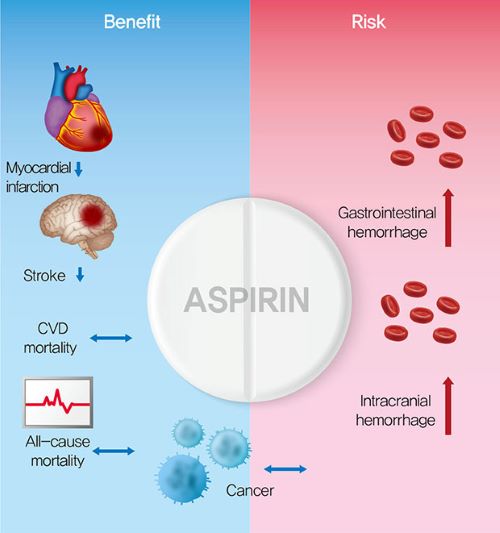
I would not try this at home. I sent my patients to a specialized medical center for treatment, Other undesirable effects induce bleeding disorders, stomach ulcers, and, in children, a very serious disease called Reye’s syndrome. The latter is so serious that aspirin is not often given to children; except when it is needed, such as in a condition called Kawasaki’s Disease, where it is very helpful.

I mention these details to counteract the blase attitude created by long use. No longer does the doctor say “Take an aspirin and call me in the morning”. For a long while, low-dose Aspirin was used in most Patients with coronary artery disease, as a method of preventing sudden clot formation. I took 65 mg. Of aspirin for years, even though I had no narrowing of my arteries.

Now it is found that aspirin can cause an excess of Hemorrhagic stroke, and it is not recommended in my age group and risk profile. Aspirin is a powerful medication with a wide variety of effects. Most of its beneficial effects have safer alternatives. Acetaminophen- Tylenol- is now used in place of Aspirin for Pain and fever relief. I suggest not using aspirin unless prescribed by a Doctor.

–Dr. C