
Tag Archives: Chronic Diseases

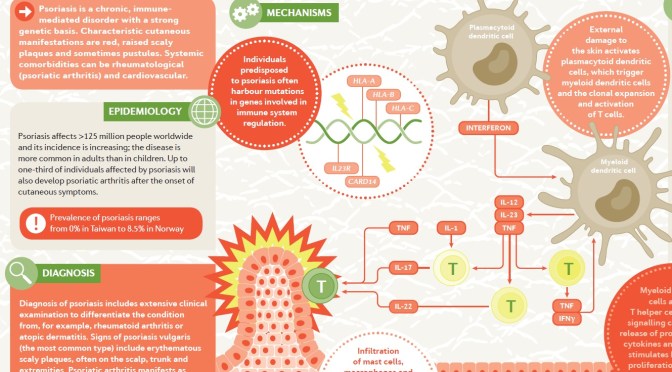
Infographic: Diagnosis & Treatment Of Psoriasis

Psoriasis is a skin disease that causes a rash with itchy, scaly patches, most commonly on the knees, elbows, trunk and scalp.

Psoriasis is a common, long-term (chronic) disease with no cure. It can be painful, interfere with sleep and make it hard to concentrate. The condition tends to go through cycles, flaring for a few weeks or months, then subsiding for a while. Common triggers in people with a genetic predisposition to psoriasis include infections, cuts or burns, and certain medications.

Treatments are available to help you manage symptoms. And you can try lifestyle habits and coping strategies to help you live better with psoriasis.

Website

COMMENTS ON ‘PSORATIC ARTHRITIS’:

My practice was restricted to allergy, but I saw many patients with psoriasis. The red scaly patches made them think they had allergic dermatitis, eczema. Psoriasis on the arm is usually located on the elbow, and atopic dermatitis on the opposite side, in the flexural area. Thick, pitted fingernails are also common in psoriasis. It’s combination with arthritis is worrisome.

Psoriasis will usually develop first, and the psoriatic arthritis will follow years later, but 10% of the time the arthritis Is the first problem. This form of arthritis can be very painful, and cause deformities. It is often worse than rheumatoid arthritis, although does not affect as many joints, and is often asymmetrical. It inflames the area where tendons attach to the bone, which is one of the reasons that it can be more painful than rheumatoid arthritis.

Psoriasis is an autoimmune problem and can involve practically any organ in the body.

It is often associated with metabolic syndrome and diabetes.

Psoriatic arthritis does not have the rheumatoid serum markers that can help diagnose rheumatoid arthritis, and unless psoriasis is also present on the skin, it can be hard to diagnose.

Symptomatic treatment with NSAIDs, physical therapy, phototherapy and topical treatments can be helpful, but very expensive biologics are sometimes needed to help out methotrexate and other first line DMARDs (Disease modifying antirheumatic drugs).

This condition can be  progressive.  If you develop scaly red patches on your skin, be sure to check with the doctor about the possibility of psoriasis.

—Dr. C.

STUDY: “FRAGMENTED SLEEP” INCREASES INFLAMMATION & HARDENING OF THE ARTERIES

From UC Berkeley (June 4, 2020):

UC Berkeley Logo

“We’ve discovered that fragmented sleep is associated with a unique pathway — chronic circulating inflammation throughout the blood stream — which, in turn, is linked to higher amounts of plaques in coronary arteries,” said study senior author Matthew Walker, a UC Berkeley professor of psychology and neuroscience.

Disrupted nightly sleep and clogged arteries tend to sneak up on us as we age. And while both disorders may seem unrelated, a new UC Berkeley study helps explain why they are, in fact, pathologically intertwined.

Some tips to improve sleep quality

  • Maintain a regular sleep routine, going to bed and waking up at the same time each day.
  • As part of a nightly wind-down routine, avoid viewing computer, smartphone and TV screens in the last hour before bedtime, and keep phones and other digital devices out of the bedroom.
  • Engage in some form of physical exercise during the day.
  • Get exposure to natural daylight, especially in the first half of the day.
  • Avoid stimulants, like caffeine, and sedatives, like alcohol, later in the day.

UC Berkeley sleep scientists have begun to reveal what it is about fragmented nightly sleep that leads to the fatty arterial plaque buildup known as atherosclerosis that can result in fatal heart disease.

Read full article

COMMENTARY

“How much sleep do we need”, and “Sleep Hygine” were past topics on this site, and my own sleep fragmentation was mentioned. This study correlates sleep fragmentation in the elderly with increased blood vessel disease compared to elderly people who have no interruptions in their sleep.

The elderly have several obstacles to a good, full night’s sleep, although a fair number of my friends claim the blessings of sleeping soundly. As we get older, we lose the deepest sleep we enjoyed as children, and there is some loss of REM sleep as well. The elderly sleep more lightly.

Diseases begin to accumulate as we get older, and These DISORDERS and their TREATMENT can disrupt sleep. I mentioned My BPH with it’s blockage of flow, leading to incomplete emptying of my bladder. This led to FREQUENT URINATION and frequent arousal at night.

With aging, the tissues in the throat become more flabby, and if you SLEEP on your BACK, your inhalation may be blocked. This may result in OBSTRUCTIVE SLEEP APNEA, where your breathing  and sleep are interrupted repeatedly. The associated SNORING may interrupt the sleep of your partner, or even the sleep of those in the next room.

GERD, where you choke on regurgitated stomach contents, is more common in the elderly.

Chronic Heart, lung and Kidney disease can interfere with sleep.
SLEEP DEPRIVATION leads to a variety of problems, such as the inflammation and Arterial blockage highlighted in the above article.

Sleep is intimately connected with DIET and EXERCISE. As one of the PILLARS of HEALTH,  It s well worth discussing with your Doctor and following her instructions.

—Dr. C.