Tag Archives: Mouth

Oral Health: Brushing, Flossing & Mouthwash

#1. If your gums are bleeding, you’re brushing too hard.

True, sometimes. Bleeding gums are usually a sign of gum disease, but over-vigorous brushing can cause gums to bleed as well. Pregnancy, poorly fitting dentures, and some medications, such as anti-clotting drugs, also can contribute to bleeding gums. However, if you’re brushing correctly (see the next question for tips!), healthy gums generally will not bleed.

#2. It doesn’t matter how I brush, as long as I brush for two minutes.

False. One of the better ways is to move your toothbrush in a circle. This is called the Modified Bass Technique. This circular motion picks up the plaque on your teeth and sweeps it out. The other ways of brushing only move the plaque and push it against other surfaces. To use the Modified Bass Technique, hold your brush at a 45-degree angle to the gum line. Let the bristles reach just beneath the gum line.

Regardless of the technique you use, it’s also possible to brush too hard. This can damage your gums and wear away tooth enamel. Gentle pressure is all that’s needed to remove debris and plaque.

Two minutes of brushing is ideal, though. If it helps, set a timer. Use a fluoride toothpaste, and floss at least once a day. Brushing and flossing before bed is especially important in order to remove food particles from your mouth before you sleep.

#3. There’s no single “right way” to floss.

False. For effective flossing, wrap the floss around the middle finger of each hand, leaving a section in the middle that’s several inches long. Use your thumbs and index fingers to hold that section. Gently work the floss into the space between two teeth and press it against one of the teeth cre­ating a C-shape, sliding it up and down a few times. Then press against the other tooth, repeat, and move to the next space. These motions scrub away the plaque. Make sure to move gently around the gums to avoid placing damaging pressure on them.

Floss holders, floss tape, and different types of floss offer something for every mouth.

#4. Electric toothbrushes are often more effective than manual ones.

True. Research has found that electric toothbrushes are better at removing plaque and reducing the risk of gingivitis. Proper use of a manual toothbrush should be as effective as an electric toothbrush, but most people don’t remove enough plaque with a manual toothbrush; they don’t brush long enough or use correct brushing techniques.

A research review by Cochrane, an independent review organization, found a “moderate benefit” for using an electric toothbrush over a manual one. And an 11-year study published in 2019 found that people who used electric toothbrushes had lower rates of tooth loss, as well as healthier gums and less plaque, compared with people using manual toothbrushes.

#5.  Mouthwash can be used instead of brushing and flossing.

False. The American Dental Association (ADA) says: “Using a mouthwash does not take the place of optimal brushing and flossing.” This doesn’t mean that mouthwash is useless, however. It can fight bad breath, and the ADA notes that some mouthwashes help reduce the risk of gum disease and tooth decay, but only if used as part of a daily oral hygiene routine.

Over-the-counter mouthwashes may be targeted toward prevent­ing decay (fluoride rinses), bad breath, mouth sores, or gum disease. Prescription mouthwashes can help treat gum disease, dry mouth, mouth sores, or dry socket. Most mouthwashes prescribed for gum disease con­tain chlorhexidine, which is also in some over-the-counter mouthwashes in lower concentrations. Talk with your dentist to decide which mouthwash is best for you.

THE DOCTORS 101 CHRONIC SYMPTOMS & CONDITIONS #54: ORAL THRUSH


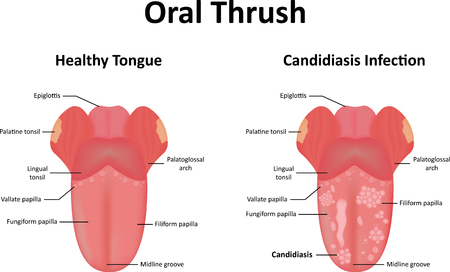
Thrush is an infection of the mouth with an organism called candida albicans. It is most common in the newborn and with young children, but can occur in adults if they have an immune deficiency,  use corticosteroid inhalers, are diabetic, or take broad-spectrum antibiotics.

A combined mother–child problem can occur with breast-feeding mothers in the newborn period. The mother’s  nipples may become infected, giving it to the baby, and they can pass back and forth. A baby who has thrush is also susceptible to diaper rash caused by candida.

There is a sense of irritation and some pain associated with thrush in the mouth, the diaper area, and the nipples. Thrush appears as cottage cheese-like areas on the throat and tongue.

The normal immunity usually keeps thrush at bay. In a newborn, however, the immune system is not fully developed. Sometimes the hormones of pregnancy facilitate thrush in the mother. Diabetes and smoking can also allow thrush.

Sometimes the thrush infection will go down into the swallowing tube, the esophagus, and produce inflammation. This can cause pain on swallowing, and is most common in AIDS and other immunodeficiency states.

Treatment of surface candida infections like throat is usually with Mycostatin– containing mouthwashes or creams. If it spreads beyond the surface, however, you will need more potent medications. Candida albicans is everywhere, and your immunity is your main defense against it.

Keep your immunity as solid as possible naturally, with good sleep, diet and exercise.

—Dr. C.

Read more

PREVENTION: THE HEALTH AND HEALING BENEFITS OF PROPER BREATHING

From a Wall Street Journal article (May 21, 2020):

Breathing properly can allow us to live longer and healthier lives. Breathing poorly, by contrast, can exacerbate and sometimes cause a laundry list of chronic diseases: asthma, anxiety, attention deficit hyperactivity disorder, hypertension and more. Poor breathing habits can even change the physical structure of our skeletons, depleting essential minerals and weakening our bones.

Most of us misunderstand breathing. We see it as passive, something that we just do. Breathe, live; stop breathing, die. But breathing is not that simple and binary. How we breathe matters, too.

Last year, I wanted to see just how dramatically breathing habits—good and bad ones—could affect my own brain and body. I’d learned that up to 50% of us are chronic mouth breathers, a problem well described by an ancient Tao text: “The breath inhaled through the mouth is called ‘Ni Ch’i, adverse breath,’ which is extremely harmful.”

Scientists have known for decades that inhaling through this pathway saps the body of moisture, irritates the lungs and loosens the soft tissues at the back of the mouth. Mouth breathing has also been linked with neurological disorders, periodontal disease and increased risk of respiratory infection. But nobody knew how quickly this damage came on.

Read full article

COMMENTARY

Breathing is something we don’t think about. It comfortably transcends the merely habitual, and there is a complex of controllers in the brain to Drive breathing should we be unable or forget to breathe voluntarily.
Breathing has it’s own poets and cults, one of which is MINDFULNESS MEDITATION, which uses our BREATHING as the focus of our consciousness, to get us outside ourselves.

With DEEP breathing,  I noticed an INCREASED pO2, as registered on my Pulse Oximeter.

In the 1960’s asthma was not so well controlled as now. The mechanics of breathing were more important, so we taught our Patients how to breathe properly.

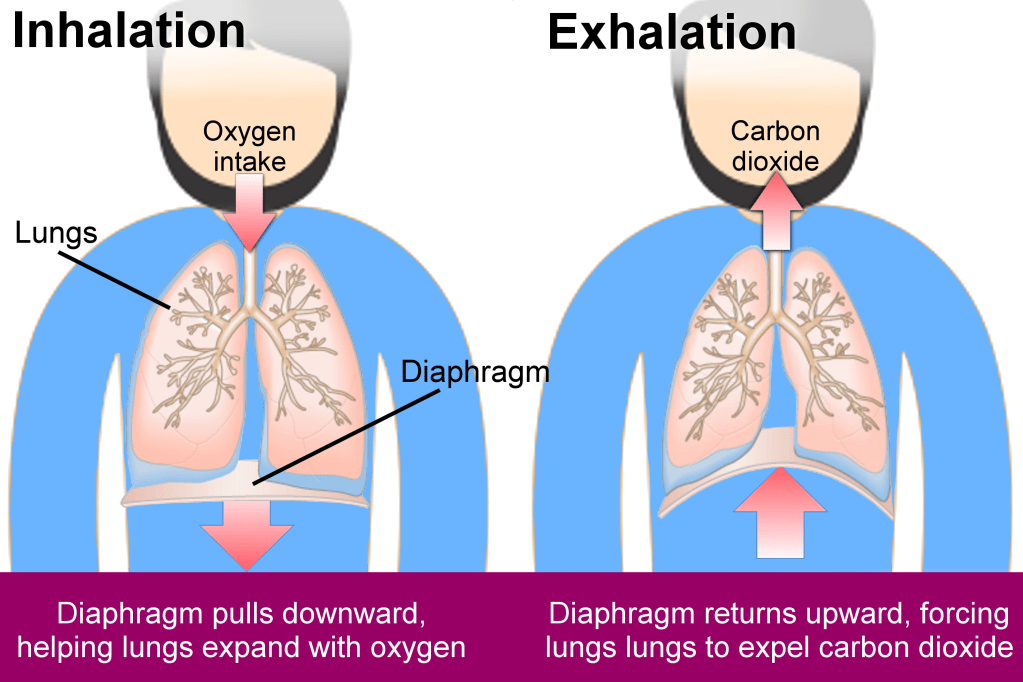
There are 2 sets of muscles we use to EXPAND our lungs, the DIAPHRAGM at the bottom of the chest, and the chest muscles themselves, the INTERCOSTALS. We refer to diaphragmatic breathing as “stomach” breathing, because the stomach bulges out as the descending diaphragm compresses the abdominal contents.

We refer to intercostal breathing as “chest” breathing because the chest expands when the inspiratory intercostals contract.

Diaphragmatic breathing is more efficient, and we encourage our asthmatic patients to Use their more efficient diaphragm to prevent them from tiring as they struggle to get their air out through their narrated airways.

You can squeeze a little extra air out of your lungs by contracting your abdominal muscles.

So to take a DEEP BREATH, see that your stomach rises and your chest expands with the breath IN, and that you squeeze both your abdomen and your chest with the breath out.

Your AIR SACS expand, your lungs are flushed with fresh air, and you blood oxygen, and BRAIN OXYGEN INCREASES with a deep breath in. The “stale air” is cleared by a full breath out.

When you are quietly breathing, letting that vital process take place automatically, notice that a deep breath, or “sigh”, occurs about once every 2 minutes. This is nature’s way to help lung surfactant PREVENT LUNG COLLAPSE and PNEUMONIA.

It is HEALTHFUL to PAY ATTENTION to your BREATHING occasionally! If uninclined to breathe deeply yourself, take a brisk walk up a hill, and let Nature do it for you.

—Dr. C.