
Tag Archives: Fungus

Fungal Infections: The Spread Of Candida Auris

Candida auris is a type of fungus, a yeast in this case, that is increasing in frequency and spreading geographically, apparently due to warmer temperatures. This organism is fairly common in hospitals, where it often is on the skin. It is lethal if it gets into the body, and often difficult to treat. Las Vegas, Nevada, in particular is having almost an epidemic of these infections, with more than 500 infections and 100 deaths since the fall of 2021.

An alarming number of cases are misdiagnosed when patients first come to the emergency room; fungal infection is certainly not the first thing a doctor thinks of when she sees a patient with a febrile illness. On the flipside of that, any delay in diagnosis, particularly with a bloodstream infection, can be lethal. There are a few good laboratory tests for the diagnosis of fungal infection, and many of these take highly trained technicians with a microscope.

Fungi are opportunistic infections, which means a healthy person is unlikely to be seriously affected. With cancer treatments and organ transplants, increasing numbers of people are on immunosuppressive drugs which means they are more susceptible. Hospitals deal with this very sick people, and frequently use central catheters inserted into patients veins, and opportunistic fungi, like candida auris, get a free ride into the body. With fever, most doctors, think first of bacterial infections, and give antibiotics; these antibiotics can actually worsen fungal infection, since they remove bacterial competitors.

Many medical schools do not teach their students about fungal infections, and in 4 years of medical school, doctors in training are lucky to get two or three hours on this subject. Fungal infections are thought to be rare.

In these days of high-tech, corporate medicine, it is good for a patient to be her own advocate. Don’t be afraid to ask the doctor if she has thought of fungal infection as possible cause if you are not improving with your treatment, particularly if you’re in the hospital.

—Dr. C.

DR. C’S JOURNAL: YEASTS – CANDIDA ALBICANS

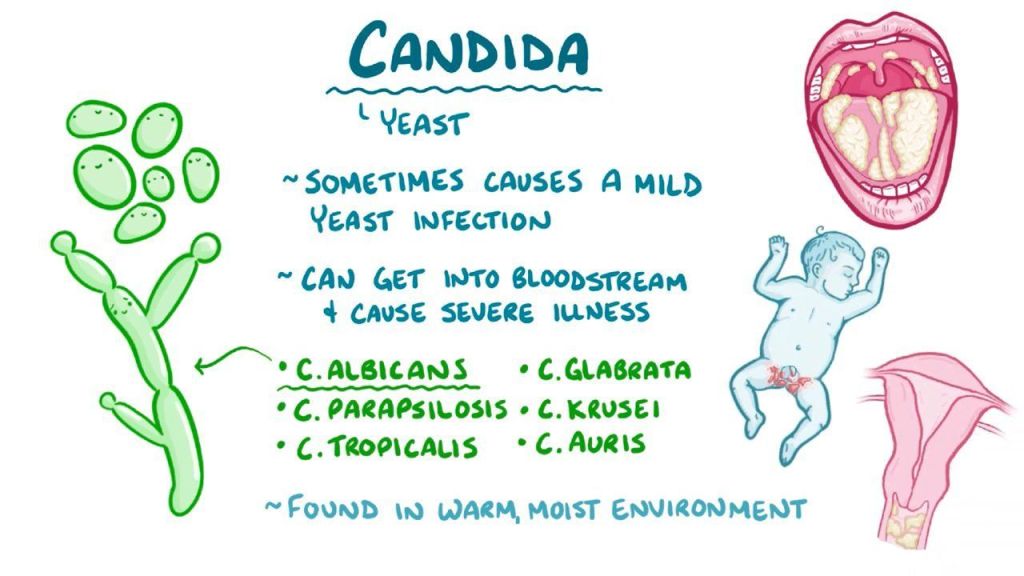
Candida albicans is a ubiquitous yeast that has evolved the ability to stick to mucocutaneous linings, e.g. mucous membranes and  skin. When present  in the mouth it is called thrush, and on the skin intertrigo, or diaper rash among other names.

Almost everybody is infested by candida in low amounts, as indicated by the common incidence of a whitish membrane (thrush)  in the mouth of people who regularly use inhaled corticosteroids for asthma. The Cortisone lowers the resistance, enabling the fungus to grow more profusely. The use of broad-spectrum antibiotics also facilitates the growth of Canada by killing off the competition.

Diabetes is a risk factor that commonly increases difficulties that people have in controlling candida growth in their oral and genital areas. Certainly anything that affects the immune system such as very young or very old age, viral infections especially AIDS, organ transplants, and chemotherapy will increase the incidence of Canada.

Due to it’s widespread presence in the body, Candida albicans is the fourth most common cause of bloodstream infections among hospitalized patients, where it grows on indwelling catheters and other in certain devices, which act as avenues for the yeast to invade the bloodstream.

Candida Auris  is a member of the same genus, Candida,that has developed some gain of function mutations to allow it to infect the body much more readily. It is very hard to get rid of, and at least one emergency room has been shut down because of a Candida Auris infestation. Another little trick that  it has evolved is resistance to most antifungal agents; The mortality rate of systemically infected people is very high.

The combination of greater infectivity and resistance to treatment makes it formidable indeed, but still it is mainly a problem for immuno suppressed individuals. C. Auris is not  as widespread as Candida albicans, and the number of cases is currently nowhere near as great. But if you get it, watch out!

As with so many other problems, it is better not see them. In other words, stay healthy with sleep, diet and exercise.

–Dr. C

THE DOCTORS 101 CHRONIC SYMPTOMS & CONDITIONS #41: COCCIDIOIDOMYCOSIS

Coccidioidomycosis, also called Valley Fever, is a silent epidemic in the western hemisphere between 40° north and 40° south. Hot summers and mild winters with an annual rainfall of 10 to 50 cm is typical.

The Fungus grows in the soil that is moist, but the soil must dry out and Be disturbed, such as  by digging, and the wind speed must pick up before you can get the arthrospores into the air so that they can be taken into the lungs.

Most infected people have minimal symptoms. Among those infected, some get a fever and a cough and recover promptly. 3 to 5% of individuals develop a chronic infection. Infected patients with a weak immune system can have disseminated coccidiomycosis affecting virtually any tissue in the body.

Notable coccidiomycosis symptoms include a profound feeling of tiredness, fever, cough, headaches, rash, muscle and joint pain. A loss of the sense of smell is also described, raising some confusion with COVID-19.

Coccidiomycosis can cause a characteristic painful bump in front of the lower leg called erythema nodosum. People with a combination fever, joint pain, and erythema nodosum are said to have “desert rheumatism”.
20% of community acquired pneumonia can be due to coccidiomycosis in endemic areas such as Phoenix Arizona and the San Joaquin Valley.

Immunizations have been evaluated for cost-effectiveness, and the results were not encouraging. More recently, A modification of the coccidiomycosis genome which prevents growth and multiplication of the spore has been tried as a vaccine in mice and found effective.

It is planned to try this noninfectious spore on dogs, who are also very susceptible to the disease. Dogs are a good choice because Government  restrictions and requirements are not so severe, and because people would do almost anything to protect their animals, promising a good market for the vaccine.

A year ago last spring, my brother had a protracted problem which involves his lungs and even his heart, and was admitted to a hospital in Phoenix. Apparently COVID-19 was ruled out, and Coccidiomycosis was diagnosed. The Doctors declined to give him amphotericin or an Azole, the  usual treatments. He recovered, was discharged, and currently is doing well with no residual symptoms.

I was planning to visit him last spring, but I’m glad I stayed home; our immune system‘s are too similar.

–Dr. C

Mayo Clinic article